The settlers' next prize
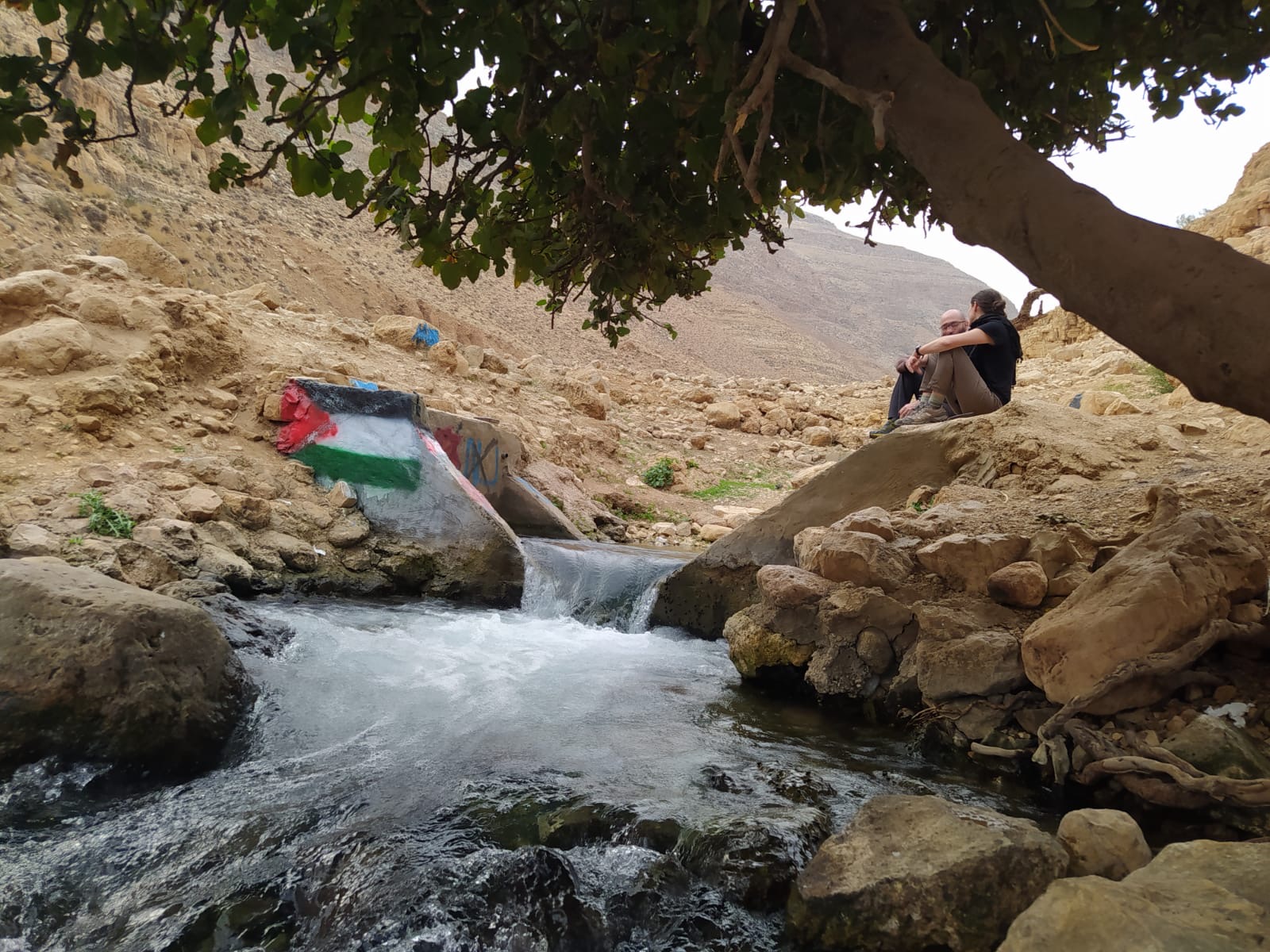

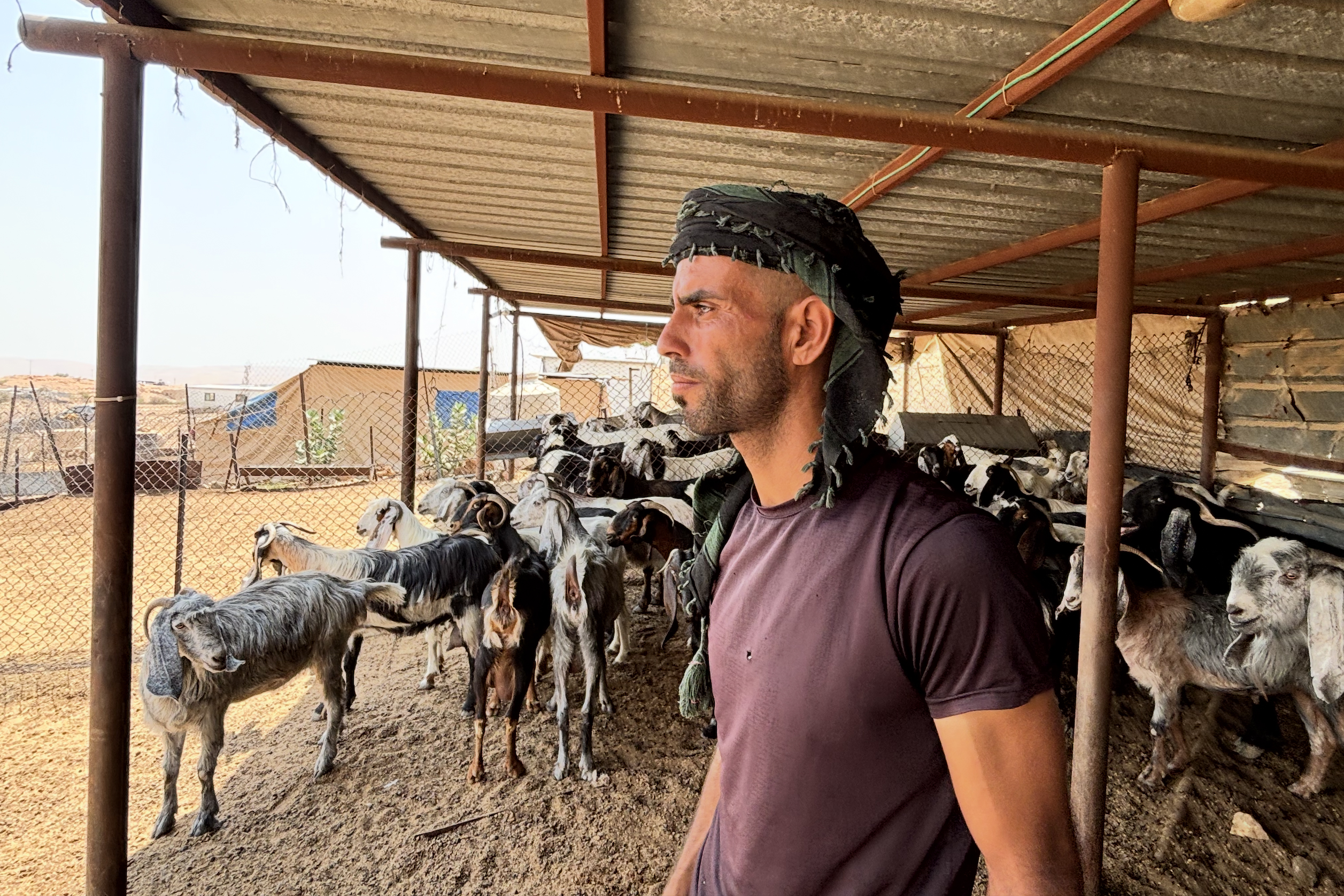
Ras Ein al-Auja, occupied West Bank - In the blistering summer heat, Farhan Ghawanmeh, 33, is struggling to keep his Bedouin community alive.
Deprived of reliable electricity, water and access to the land that its members rely on for their livelihood in the eastern West Bank, the community is on the brink of collapse.
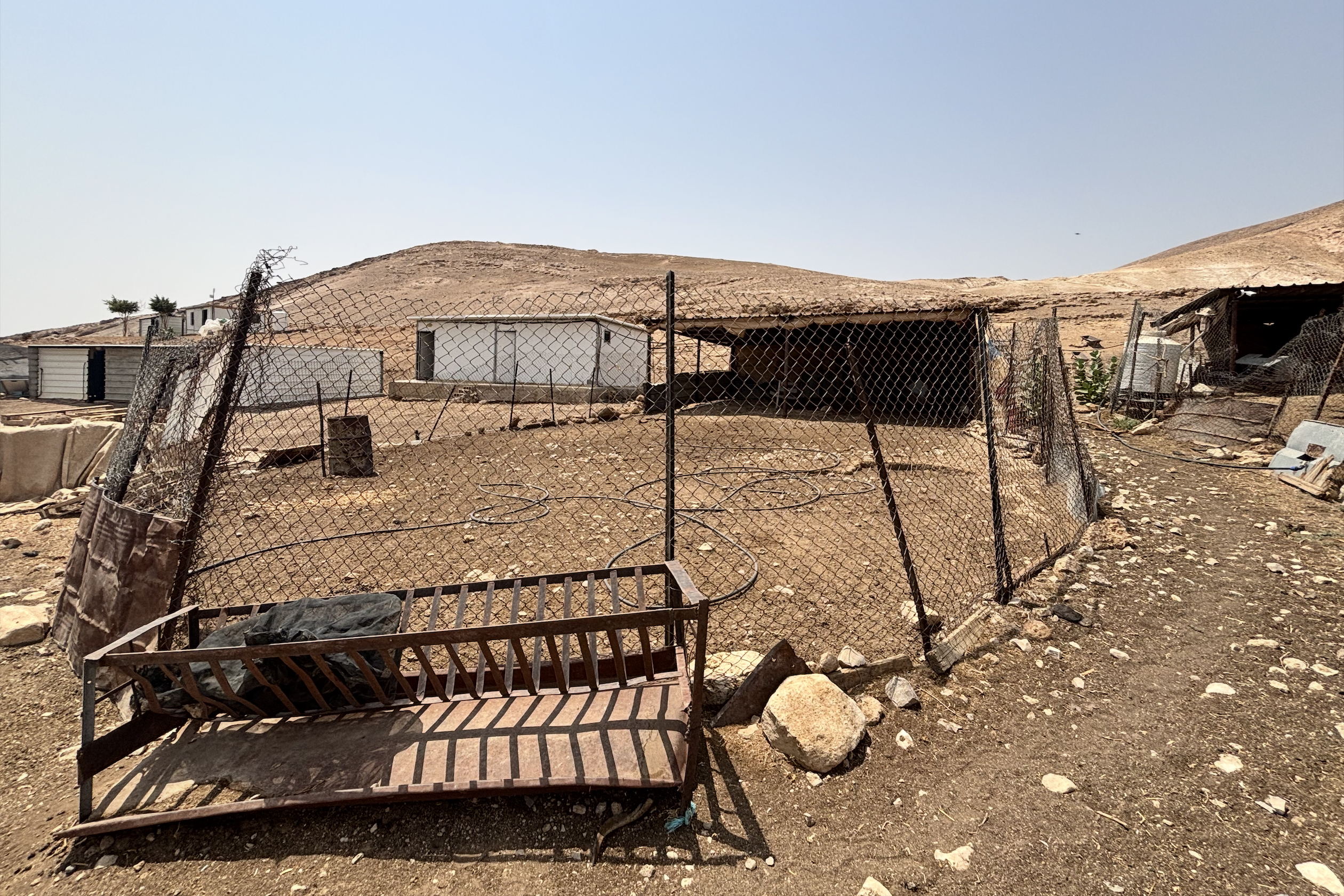
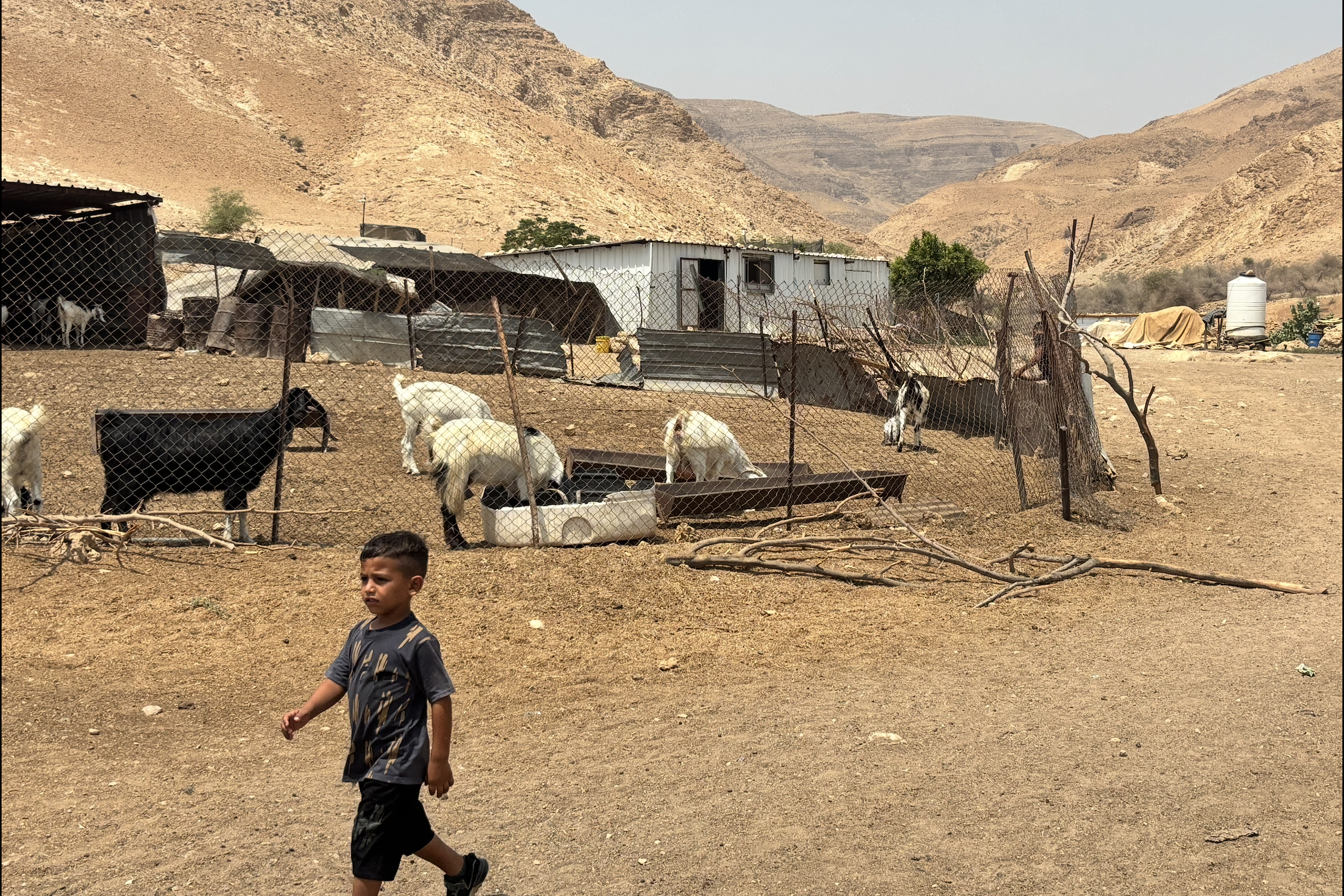
The community once owned about 24,000 head of livestock as part of its herding way of life. Now, it is left with about 3,000.
Pens once containing hundreds of sheep and goats are empty after a series of killings and thefts of livestock and rounds of sell-offs by herders desperate for infusions of cash.
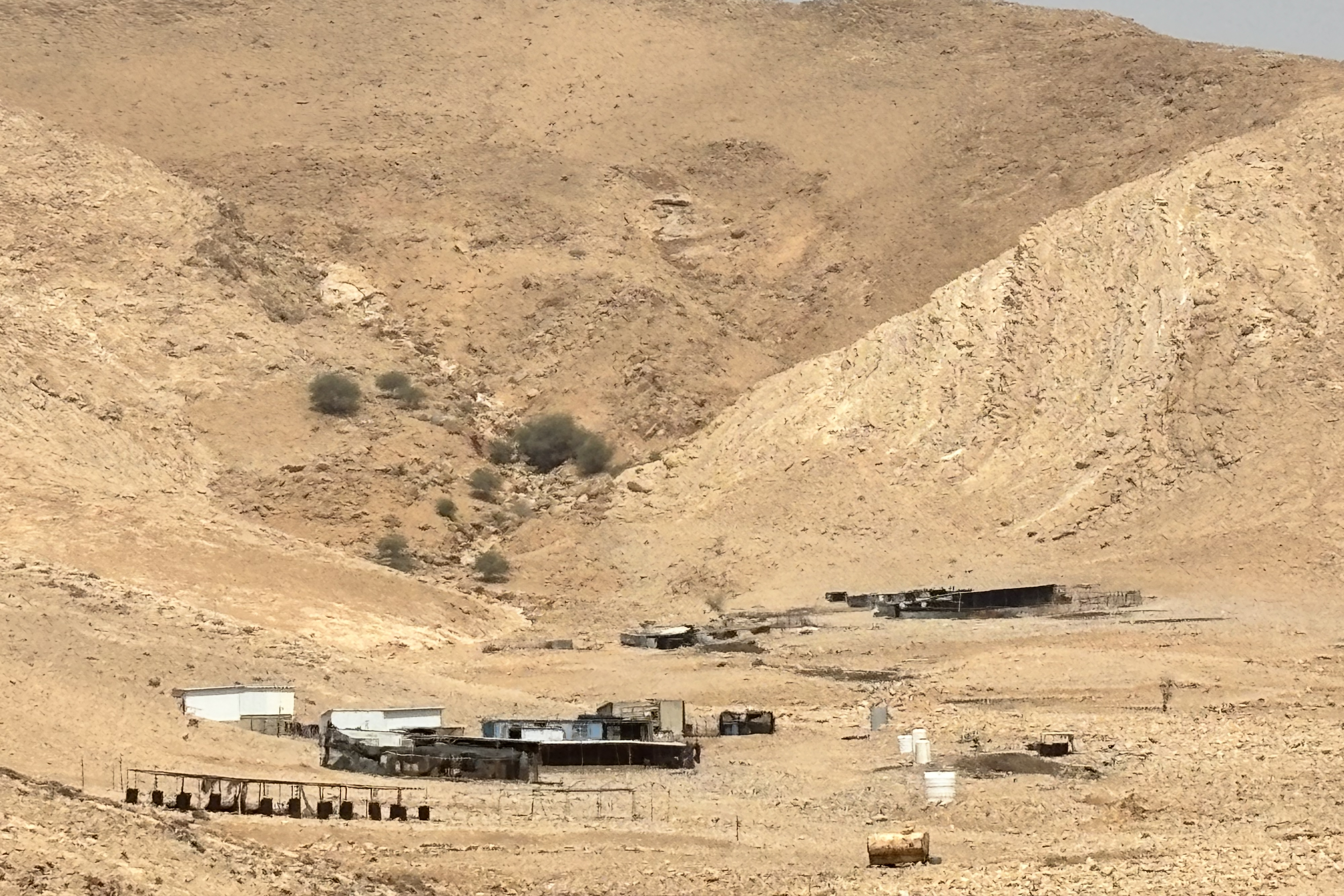
The newest Israeli settler outpost was built in August just 100 metres (110 yards) from the nearest Palestinian family. The outposts in the area now hem in the village’s approximately 900 inhabitants on three sides. Like all Israeli outposts and settlements on occupied Palestinian land, these are illegal under international law.
The family located closest to the new outpost is planning to leave, fearing for the lives of their children.
“The settler outposts are becoming closer, more intense, more violent, and we’re even more surrounded,” said Ghawanmeh, an appointed representative for the community.
The settlers, mimicking the shepherding lifestyle of the indigenous Bedouin communities, come into the village with their livestock daily, according to Ghawanmeh, taking “shifts” from 6am to 9pm.
The settler shepherds are typically teenagers under the age of 18, putting villagers in the position that if they try to interfere in the settlers’ incursions or even talk to them, they face accusations of “attacking” children and possible arrest.
Even after the war in Gaza commenced in October 2023, unleashing a wave of expulsions of Bedouin communities in Area C of the West Bank, humanitarian coordinators viewed Ras Ein al-Auja, located about 10.3km (6.5 miles) northwest of Jericho, as being at lower risk of forcible displacement compared with other herding villages.
The West Bank is divided into Areas A, B and C, corresponding to the degree of Israeli and Palestinian control. Area C, the largest, is under total Israeli military and administrative control. Area A is administered by the Palestinian Authority (PA) and Area B by both the PA and Israel.
Made up of 130 families, Ras Ein al-Auja is the biggest Bedouin herding community in Area C, stretching across an area of 20,000 dunums (20sq km or 7.7sq miles).
The community, established before 1967, also had access to the lush Wadi al-Auja spring with infrastructure built by the Palestinian Water Authority.
But with nearly all other Bedouin communities in the area stretching from Jericho up to Taybeh - a distance of about 16km (10 miles) - forcibly displaced, Ras Ein al-Auja is viewed by Palestinians as the settlers’ next prize.
Trapped at home
On a sweltering summer day, the insides of villagers’ homes in Ras Ein al-Auja smelled of rot. The villagers said that the day before, settlers had - not for the first time - severed the power lines between their homes and the off-grid electricity networks the community had built up with help from humanitarian organisations, causing the food in their refrigerators to spoil.
Israeli authorities have long denied access to basic services such as water, electricity and sanitation to this Palestinian community and others in Area C, and almost all of these communities face demolition orders. Israel typically accuses Palestinians of building without permits to justify the orders, but it makes it near impossible to acquire the permits.
The Israeli military did not respond to Al Jazeera's request for comment for this article.
According to Ghawanmeh, Israeli settlers from the three surrounding outposts - all established in the past two years - cut the off-grid electricity systems “five or six times a week”.
Last year, settlers prohibited the Bedouins from accessing the al-Auja spring, which locals depend on for both their herds’ and their own water needs. The Palestinian villagers and local reports indicate that Israeli military forces allowed the settlers to block access to the spring.
Now, all of the land where the Palestinian locals had grazed their herds is off-limits, forcing them to keep their livestock penned up.
Ibrahim Kaabneh, 35, has only 40 sheep and goats left. He once had 250, but he said he sold most of his herd after he and a relative were attacked by settlers last year and the settlers stole his relatives’ herd.
“I needed to get money to feed the rest of the herd before they would die or be stolen by the settlers,” he said inside his sparse family home with his children looking on quietly in the summer heat.
With settlers attacking them if they bring out their herds to graze and no longer able to access the water spring as well as being denied access to the nearby water pipes connected to Israeli settlements, Kaabneh now must spend about 200 shekels ($60) a day on fodder for his animals while paying for water tanks every two days.
“Even the livestock that we still have, we feel like they're not ours,” Kaabneh said. “Any moment, they can be stolen. Any moment, they can be attacked.”
Kaabneh lives about 200 metres (220 yards) away from a second Israeli outpost that was established a year ago. The outpost, containing a corrugated iron pen allegedly stolen from an already-expelled Bedouin community nearby, is a preview of what the newest outpost will look like as it expands, according to locals.
The outpost established in August is even closer to the Bedouins living here. This has added to the fears among community members who feel “suffocated” by encroaching settlers. Since the war in Gaza started, settlers have burned homes in the community and are alleged to have assaulted community members, including Kaabneh’s uncle, who was struck by a bulldozer. Settlers also come to the village inappropriately dressed or drunk, the Palestinians say.
Kaabneh says he has trouble sleeping, and he is wary of leaving his home even to get groceries because he fears for his family. Women and children avoid leaving their homes for more than an hour or two at a time.
An access road to the community - built with funding from the United States Agency for International Development, as a billboard attests - now has at its entrance a series of concrete blocks painted with Israeli flags, and community members face constant harassment to run the most basic of errands.
“Once we step outside of the house, it seems like we’re doing something wrong or we’re doing something illegal,” Ghawanmeh explained. “Children, the women and everyone here is in constant fear and in constant danger whenever they leave the house for whatever necessary reason.”
“What we are living at the moment is a disaster,” he continued. “To move from accessing 20,000 dunums of land to accessing nothing and from having a free water source to now not having it at all is crippling.”
'No space is safe in the West Bank'
Most families in Ras Ein al-Auja said that if they had any option to leave, they would - but they have nowhere else to go.
Kaabneh mentioned one uncle of his from the former community of Ein Samiya. This community, forcibly displaced by settler violence before the Gaza war, moved to the area of Khirbet Abu Falah in Area B, hoping to escape the settler violence. However, he said, the same settler who was attacking them in Ein Samiya had followed them to their new location and launched new attacks from outposts created there.
“It's not a question of whether we want to leave or not,” Kaabneh said. “Even if we leave, we will still face attacks and pressure to leave our homes and our places or whatever place we move. No space is safe in the West Bank.”
The accounts from Kaabneh and Ghawanmeh corroborate troubling trends that humanitarian workers, activists and civil society groups have described about the settler takeover of Palestinian lands that were once seen as out of the reach of settlers - including not only a large Bedouin community like Ras Ein al-Auja but even larger towns.
“Once they finish one community, they go to the next one,” said Dror Etkes, the founder of the Israeli NGO Kerem Navot, who spends much of his time in the West Bank tracking settler developments. “It's very clear that settler violence is encroaching more to Area B and A. And it's very clear that their overall objective is to force Palestinians into built-up areas and to kill the herding culture and lifestyle altogether in the West Bank.”
This newest phase in the settler takeover of Palestinian lands follows nearly two years of unrelenting pressure and violence towards Palestinian communities in Area C, driven in large part by settler shepherd outposts that serve as springboards for settler attacks. According to a report by the Israeli NGOs Peace Now and Kerem Navot released in early April, settler shepherd outposts have managed to take over 786,000 dunums (786sq km or 303sq miles) of land, or about 14 percent of all of the West Bank.
In Etkes’s rough estimations, since the release of that report, settlers have managed to take over “at least tens of thousands of dunums” more of land.
The successes of settlers in forcibly displacing entire Palestinian communities reverberates among those who remain. “Whenever we receive any news from other communities, it sparks fear and terror,” Ghawanmeh said. “These are not two or three families - it's a whole village. If this happened to that community, this is going to happen to us soon. And when and if it happens, where are we going?”
“The [remaining] communities see what happened to the [already displaced] communities,” Allegra Pacheco said.
Pacheco leads the West Bank Consortium, a partnership of international NGOs and European donors working to prevent the forcible displacement of Palestinians in Area C of the West Bank and occupied East Jerusalem.
“They know that if they don’t leave in time, the settlers could steal their sheep, steal their herds, commit enormous violence and even arson, and the army doesn’t stop this," Pacheco said. "They've seen what's happened to other communities, and they always say that’s why they decided to flee.”
The Israeli military’s forcible displacement of more than 40,000 people from West Bank refugee camps in Tulkarem and Jenin late last year added to this insecurity among larger communities like Ras Ein al-Auja.
“The size of the village doesn't make any difference,” Ghawanmeh said, “because you already see what happened to the refugee camps in the north.”
Settlers rejoice
Fears have grown as settlers rejoice over their widening land grabs. After the forced displacements of the latest communities - al-Mughayyir al-Deir and al-Muarrajat - in the large area east of Ramallah, a far-right settler leader boasted in settler chat groups of their victory in creating “Jewish contiguity” in an area spanning 381,000sq km (147,000sq miles) - “larger than the size of the Gaza Strip”.
“This is how redemption looks like,” the settler leader proclaimed in a WhatsApp post.
The settler playbook is to position new settler outposts even closer to Palestinian communities - and with even more unbridled violence, according to Etkes and Pacheco.
![New Israeli outposts have been built, including near the village of Khan al-Ahmar [Al Jazeera]](/wp-content/uploads/2025/09/New-outpost-over-Khan-al-ahmar-uncircled-1757344937.jpg?w=770&quality=80)
“The last significant attack that pushed everyone out from the community”, said Suleiman Mleihat, once a leader in al-Muarrajat, "is the fact that Israeli settlers established a settler outpost in the middle of the community."
From there, he explained, life became intolerable with even the most basic sense of security gone.
According to the United Nations Office for the Coordination of Humanitarian Affairs (OCHA), in the first six months of 2025, settlers carried out 759 attacks against Palestinians resulting in casualties and/or property damage, a number that is on pace to break 2024’s record of 1,449.
‘It’s moving up to a new level’
With so much territory in Area C cleared of Palestinian inhabitants now, settlers are extending their reach into new areas of Area C and even Area B.
“Our project, really, is [focused on] Area C - to protect the communities in C,” Pacheco said. “No one, no one ever thought Area B needs this kind of protection. It's moving up to a new level.”
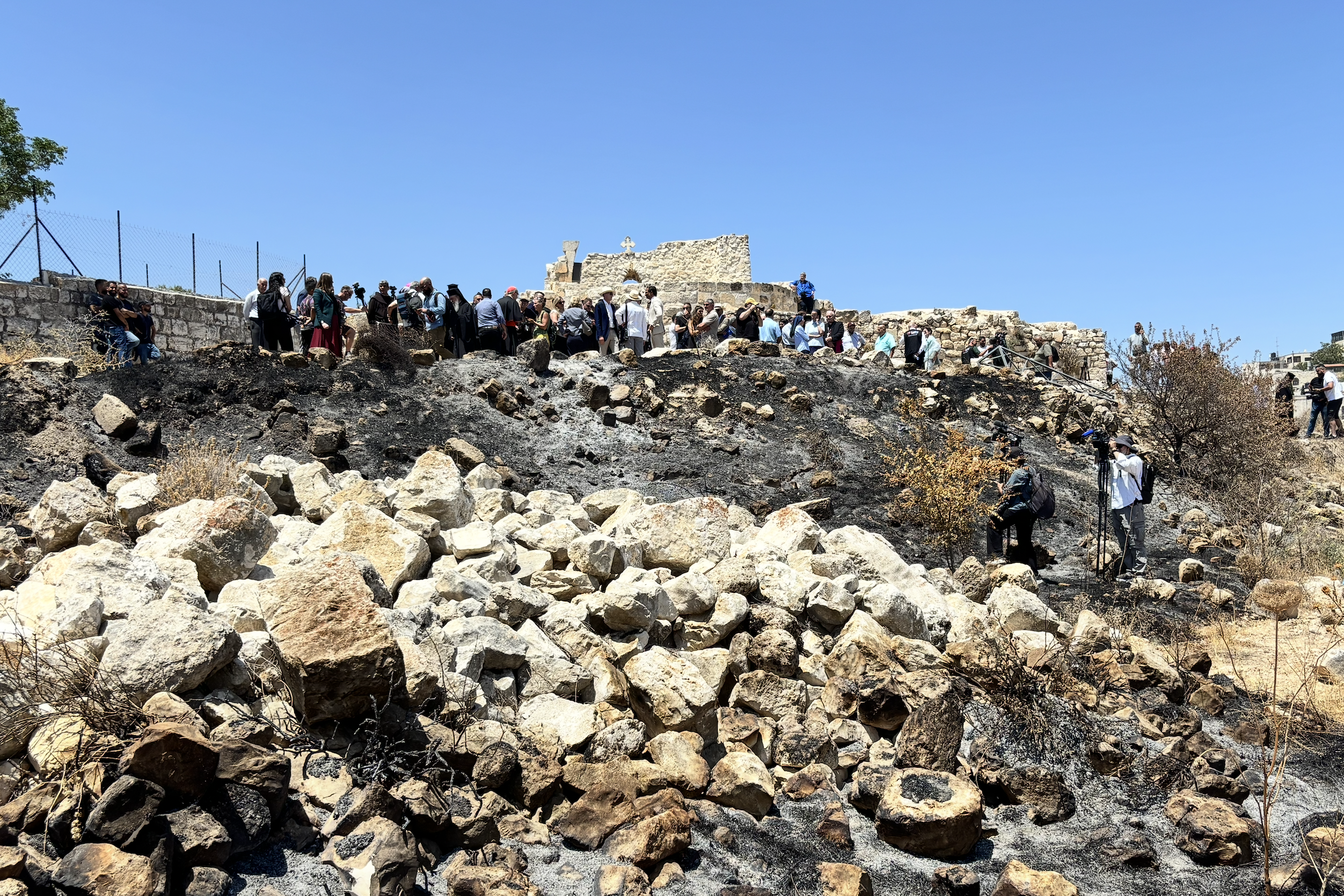
With surrounding Bedouin villages now cleared out, Taybeh, the only remaining fully Christian village in the West Bank, has become the settlers’ next target.
Their campaign has included arson attacks directed at cars in the town as well as the centuries-old St George Church and the nearby Christian cemetery. These developments mirror attacks within the town of Kafr Malik in June and in Sinjil in July, all along this “outer ring” of Area B from east of Ramallah up towards Nablus.
“In recent months, Taybeh has witnessed a dangerous escalation of settler attacks on its lands and holy places,” Father Bashar Fawadleh, a Catholic priest based in Taybeh, said at a news conference in July. “Lands cultivated with love are burned. Armed settlers trespass our lands. We cannot access our own olive trees. Citizens are terrorised at night and besieged by day. We are surrounded by iron gates, choked by military checkpoints, as if we are strangers in our own land.”
Etkes noted these settler incursions into Area B are also deepening in the area of Deir Dibwan near Ramallah as well as the area southeast of Bethlehem, where recent forced expulsions of Palestinian shepherding villages have created contiguity of settler lands between the settlements of Tekoa and Maale Amos.
“The next targets are the [Area] B communities and especially the outer B communities. This is all about taking as much land as possible,” Pacheco said. “Their goal is to empty out C and even push people out of B.”
Etkes sees a clear trend in how outposts are now being established - often at access points into Palestinian villages and towns - with the aim of creating further contiguity of Israeli settlements, particularly along major roads.
With the Allon Road (running north-south in the eastern West Bank) now clear of Bedouin villages, the focus now turns to the villages that lie along other major roads like Highway 1, according to Etkes. Evidence for this tactic can be seen in the newly established outposts along this corridor, including the area east of Ramallah. Such developments appear to create an Israeli-only corridor stretching along Highway 1 from the Jordan Valley all the way to Jerusalem.
All the while, the noose of outposts on Palestinian communities grows tighter.
“Take a look at Duma. Take a look at al-Mughayyir. Take a look at Taybeh,” Etkes said. “You can see along the Allon Road outposts which were established in the last year deliberately in a way that they will be very close [to Palestinian towns].”
Turning a blind eye
In previous years, there were still efforts by Israeli authorities to prevent the building of outposts in Area B or dismantle them. But locals and analysts described a new low this summer in law enforcement against these outposts, built illegally even under Israeli law. “There is zero - zero - law enforcement now,” Etkes said. “The military is completely with [the settlers], even [more than] compared to last summer.”
In several cases of depopulated villages, such as Wadi al-Siq and Khirbet Zanuta, Israeli courts have ordered Israel to allow Palestinians to return to their homes, only for the Israeli military and police to fail to ensure their safety from settler violence.
Palestinians believe that the establishment of outposts extending into Palestinian territory are serving as bases for settlers to take over larger lands in areas east of Ramallah, the Jordan Valley and southeast of Bethlehem.
All of this has led to settlers entering new communities deeper than ever and more viciously, according to local Palestinians, activists and analysts.
One significant factor in this deterioration has been the July 2024 replacement of Yehuda Fox as the commander of the Israeli military in the West Bank with Avi Bluth, who grew up in the settlement of Halamish.
Such changes in the military under the current far-right government, driven by political figures such as National Security Minister Itamar Ben-Gvir and Finance Minister Bezalel Smotrich, have created on the ground a sense of complete impunity for settler encroachment. Etkes cited recent examples like Ben-Gvir visiting an outpost near Sa’ir in the Bethlehem area accompanied by the head of Israeli police in the West Bank. “The situation was very bad before, but we never saw the head of Israeli police in the West Bank sitting in an illegal outpost,” Etkes said.
This explosion of new outposts - and building them closer to or, in the case of al-Muarrajat, even within Palestinian communities - is pushed by a sense of opportunity among settlers while the current far-right Israeli government remains in power.
“The goal is to empty out as many Palestinian communities here in Area C as fast as possible while this government still is in power,” Pacheco said.
Summer is always a bad time for settler violence, Etkes explained. With school out of session, these shepherding outposts have at their disposal more teenagers serving as foot soldiers and carrying out violent incursions. But with the military operating now in near-total lockstep with the most far-right settlers and the sense of urgency among settler groups, these three factors have driven the most devastating summer yet for Palestinians in the West Bank.
According to OCHA, the rate of Palestinians injured by Israeli settlers more than doubled to about 100 each month in June and July compared with an average of 49 per month from January to May while more than tripling the average of 30 per month in 2024.
One Palestinian humanitarian coordinator in Area C who asked to remain anonymous due to not being authorised to speak to the media estimated that up to 80 percent of Palestinian communities in Area C are at risk of forcible displacement by the end of the year.
“The situation here is too similar to the siege in Gaza,” Ghawanmeh said. “We’re not allowed to do anything: no water, no electricity, no work, constant threat, no safety, no security, no food.”
All of this leaves villagers like Ghawanmeh’s brother, Sliman Ghawanmeh, from Ras Ein al-Auja calling for real protection by the international community - including sanctions against the Israeli government - before it’s too late.
“It's not about having another option as a way to forget about my own land,” Sliman Ghawanmeh said with indignation in his voice. “I've been here for 43 years. I was born here. There were no settlers around. And now, a child comes from Europe and threatens me to leave my house in 24 hours. Who the hell are you? They cut access for us Palestinians to anything that makes life liveable. And then, they threaten us: You either leave, or you die.”
“This is the status quo,” he concluded. “We are left with nothing but our lives, and now even that is threatened.”
