More Palestinians return to Gaza via Rafah as Israeli attacks continue
Those returning to Gaza have described being subjected to humiliating searches and interrogations by the Israeli military.
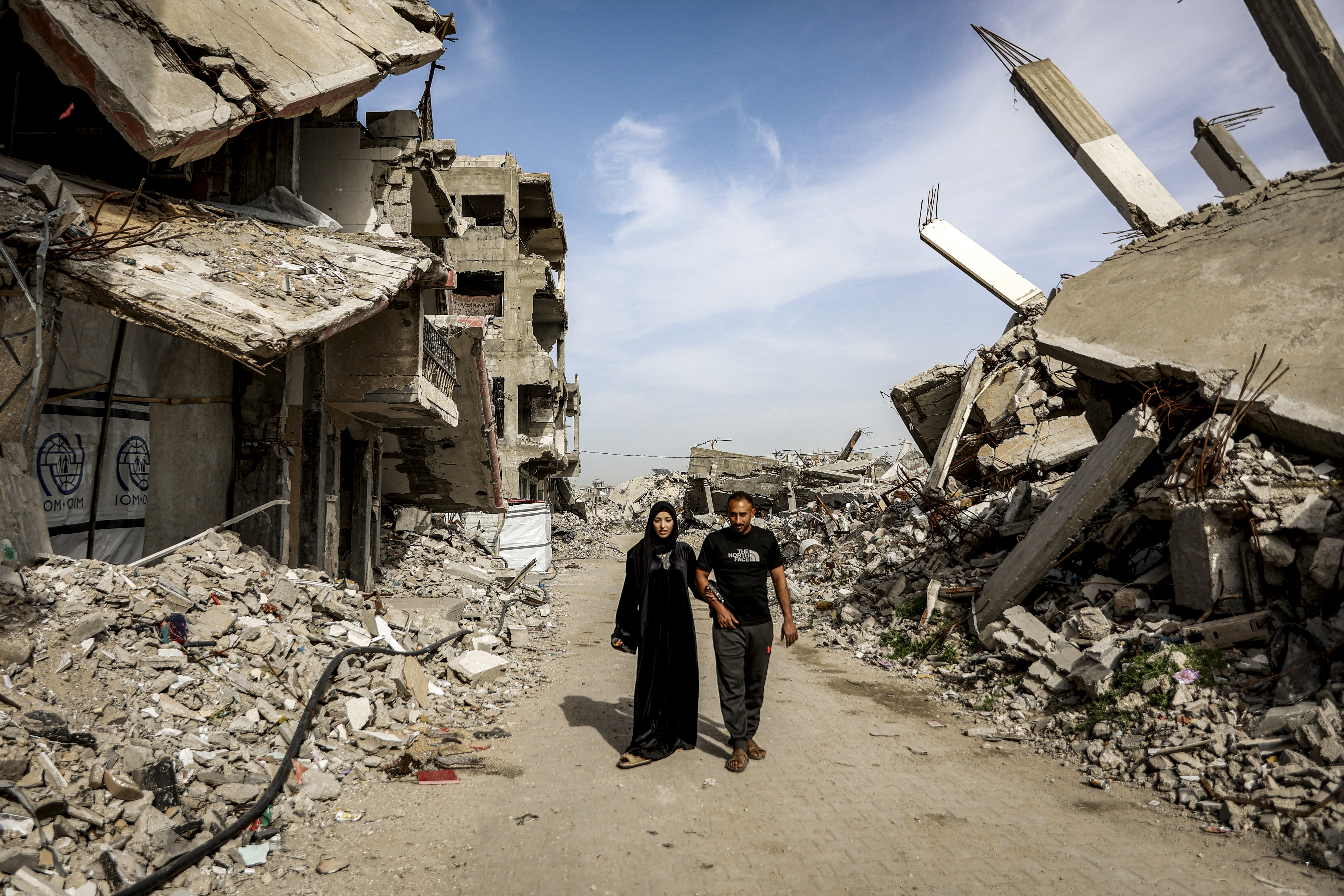
Forty-one Palestinians have arrived in Gaza via the Rafah crossing, becoming the seventh batch of returnees to make the journey since the partial reopening of the key transit point earlier this month, a painfully slow process riven by Israeli military control.
The group of returnees arrived on Tuesday evening in World Health Organization buses, and were taken to the Nasser Medical Complex in Khan Younis, an Al Jazeera team on the ground reported.
Recommended Stories
list of 4 items- list 1 of 4Four Palestinians killed in Israeli air attack on Gaza residential building
- list 2 of 4Israel used weapons in Gaza that made thousands of Palestinians evaporate
- list 3 of 4Palestinians fear West Bank annexation after Israel approves new rules
- list 4 of 4Young and old struggle to get their studies back on track in Gaza
Like those who have previously made the journey, the returnees described being subjected to humiliating searches and interrogations by the Israeli military, which controls the Palestinian side of the key crossing point.
The Rafah crossing on the border with Egypt – the only way in or out of the enclave for nearly all of Gaza’s more than two million residents – was kept shut by Israeli authorities for most of its genocidal war and only partially reopened on February 2.
With its reopening, a key condition of the United States-brokered “ceasefire” deal intended to end the war, Israel is allowing a limited number of pre-approved and heavily vetted people to travel, allowing Palestinians who had left during the war and been stranded outside to return, and enabling the transfer of patients desperately needing medical treatment in other countries.
With the latest arrivals, 172 Palestinians have returned to the Gaza Strip since the crossing’s reopening, while a mere 250 people – patients requiring medical treatment abroad, and their companions – have left, Gaza’s Government Media Office says.
The pace of medical evacuations since the crossing’s partial reopening has been slower than the numbers promised – the “ceasefire” agreement mentioned 50 patients leaving the Strip each day, each accompanied by two family members – far short of what was required to meet the needs of the approximately 20,000 patients in need of medical treatment in other countries.
Gaza’s healthcare system has been decimated by Israel’s genocidal war on the enclave, with 22 hospitals put out of service and 1,700 medical workers killed, according to the Palestinian Health Ministry.
Israeli attacks continue
Meanwhile, despite the supposed “ceasefire” agreement implemented in October, Israeli attacks have continued to target the Strip on a near-daily basis.
On Wednesday, a Palestinian child was wounded by Israeli gunfire in the Batn as-Sameen area, south of Khan Younis, the Wafa news agency reported, citing medical sources.
Israeli air strikes and artillery shelling also targeted areas under Israeli military control east of Khan Younis in the south of the Strip, an Al Jazeera team on the ground reported.
The latest violations of the “ceasefire” came after at least seven Palestinians were killed in Israeli attacks in Gaza on Tuesday.
Among the victims were at least three people killed by Israeli shelling and gunfire in central Gaza, and another killed by Israeli army fire north of Khan Younis.
Since the agreement came into force into October, 591 Palestinians have been killed and 1,578 injured, according to the Health Ministry, while 72,045 Palestinians have been killed since the start of the war.
Israel has violated the “ceasefire” agreement at least 1,620 times from October 10, 2025 to February 10, 2026, through the continuation of attacks by air, artillery and direct shootings, the Government Media Office in Gaza says.
In response to the latest attacks, Agnes Callamard, secretary general of Amnesty International, said in a post on X that Israel’s “genocide of Gaza has not stopped”.
“This would require a stop to all genocidal acts and clear evidence that there is no evidence of genocidal intent. This would also require initiating justice and accountability for all victims,” she said.
“We are very, very far from such a situation.”
Israel approves forced expulsions
The attacks came as Israel announced it had approved the forced expulsion of two Palestinians convicted of crimes in Israel to Gaza, in an unprecedented move that has been condemned by rights groups.
The move is the first implementation of a law passed in February 2023 that allows for the revocation of citizenship and the deportation of those convicted of “terrorism”.
Israeli Prime Minister Benjamin Netanyahu announced on X that he signed the revocation of citizenship and deportation orders for two Palestinian citizens of Israel who allegedly carried out stabbing and shooting attacks.
“I thank the coalition leader [Ofir Katz] for leading the law that will expel them from the State of Israel, and many more like them are on the way,” Netanyahu wrote.
The two men to be deported were identified in a statement from Katz as Mahmoud Ahmad, sentenced to 23 years in prison for shooting Israeli soldiers and civilians, and Mohammed Ahmad Hussein al-Halsi, sentenced in 2016 to 18 years for stabbing elderly women in Armon HaNatziv.
Israeli media reported that the two will be sent to Gaza once their sentences are complete.
Move ‘destroys protection of citizenship’
Adalah, a legal centre for Palestinian rights in Israel, has condemned the move, saying in a statement that the “deportation orders allow Palestinian citizens of Israel to be physically exiled from their homeland”.
Describing the move as “unprecedented”, Adalah said Israel’s action “violates the absolute international prohibition against statelessness and destroys the most foundational basic protection of citizenship”.
“The government has transformed the most fundamental human right into a conditional permit that can be revoked at will,” the group said.
Hassan Jabareen, the group’s general director, told Al Jazeera that the Israeli government’s push to revoke the citizenship of Palestinians in Israel is part of a wider “war against Palestinians” across all the areas under its control.
“Palestinians in Gaza are under genocide. Palestinians in the West Bank are facing the violence of the settlers, the violence of the army. And now Palestinian citizens are facing the threat of revoking their citizenship,” he said.
Jabareen said this will set “a precedent” against Palestinians in Israel, who account for about 20 percent of the country’s population.
“This will open the way to transfer [Palestinians out of Israel] based on political reasons,” he said.
“Although the law has neutral language … [it] will apply only to Palestinian citizens because the state has discretion to use it, and they will use it only against Palestinians.”
