Saudi-backed forces move on Aden as Yemen secessionist leader vanishes
Coalition says it targeted secessionist forces after Aidarous al-Zubaidi fled hours before he was due for talks in Riyadh.
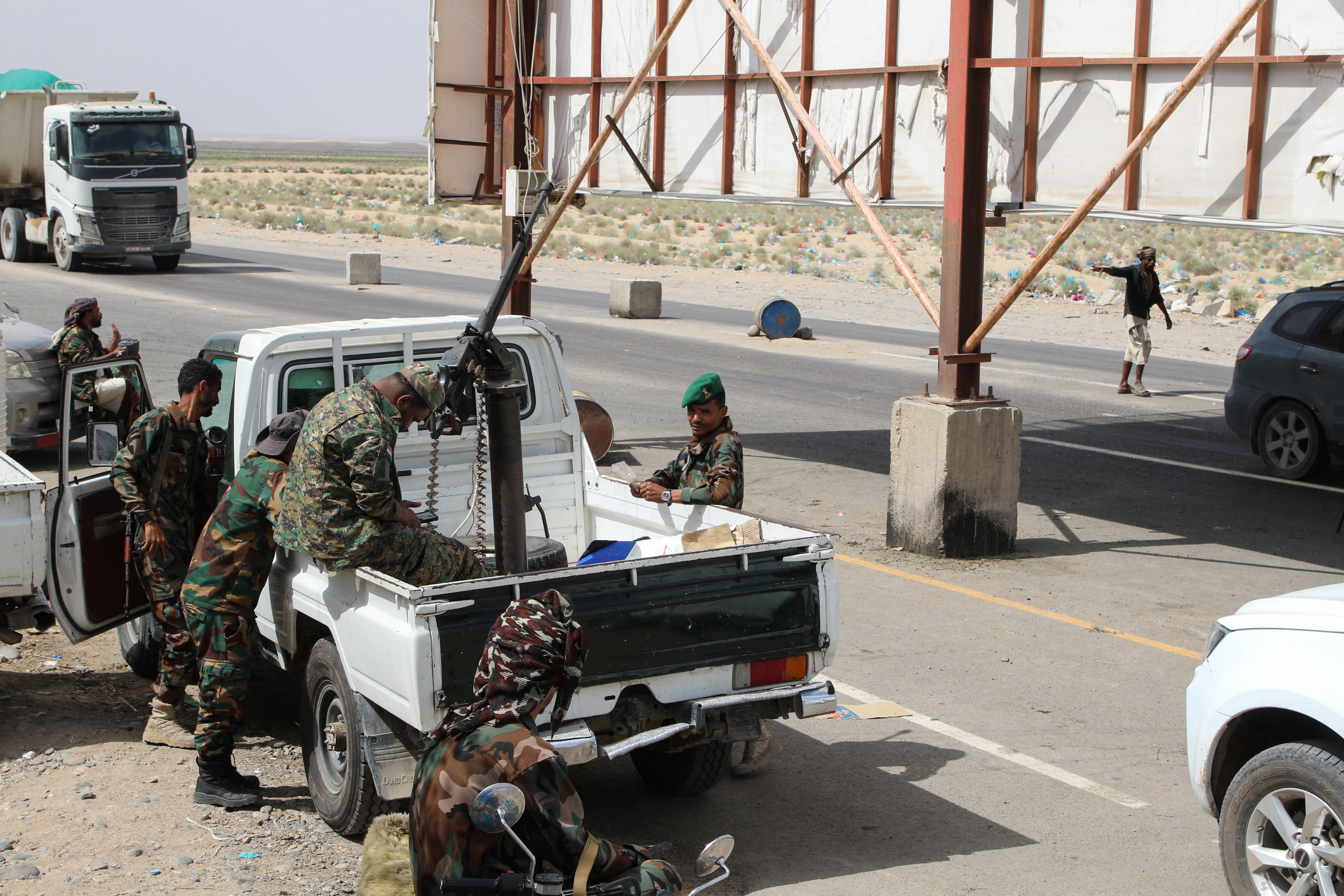
Saudi-led coalition attacks south Yemen separatists
The Saudi Arabia-led coalition launched air strikes on southern Yemen saying it targeted secessionist forces after their leader disappeared instead of boarding a plane scheduled to take him to talks in Riyadh.
Saudi-backed ground forces on Wednesday moved on the Yemeni city of Aden, a stronghold of the southern secessionists supported by the United Arab Emirates (UAE).
Recommended Stories
list of 4 items- list 1 of 4Yemeni separatists to attend Saudi talks after losing key southern sites
- list 2 of 4Hundreds of tourists stuck on Yemeni island as tensions simmer on mainland
- list 3 of 4Saudi-backed government forces retake multiple cities in southern Yemen
- list 4 of 4Egypt says it shares ‘identical’ views with Saudi Arabia on Yemen, Sudan
A Yemeni government official, speaking on condition of anonymity, told Al Jazeera forces loyal to the separatist Southern Transitional Council (STC) pulled out from all districts of Aden governorate, and its troops seized control of the international airport.
Reporting from Sanaa, journalist Yousef Mawry said the presidential palace in Aden had also been overtaken by Yemeni government forces, who also seized control of all exit and entry points to the city.
Some officials from the STC, however, said the group is still in control of Aden.
Mawry reported 10 government soldiers had been killed and wounded in the city of Ataq, in Shabwah province, another stronghold of the secessionist movement.
Yemen’s separatist authorities imposed a night-time curfew in Aden. The 9pm to 6am (18:00 GMT to 03:00 GMT) curfew was announced by STC deputy leader Abdulrahman al-Mahrami, who is in charge of armed forces patrolling the southern city.
‘Unknown location’
In a statement, the coalition said the leader of the STC, Aidarous al-Zubaidi, was due to fly out from the Yemeni city of Aden for talks on ending the conflict between his group and the internationally recognised government of Yemen.
But al-Zubaidi did not board the plane and “fled to an unknown location”, it said. His current whereabouts remain unclear.
“During this time, the legitimate government and the coalition received information that al-Zubaidi had mobilised a large force, including armoured and combat vehicles, heavy and light weapons, as well as munitions,” the coalition said.
The force left Aden at around midnight and was later located in the southern Dhale governorate, it added. The coalition launched “preemptive strikes” at 4am local time (01:00 GMT) to disable those forces and thwart al-Zubaidi’s “attempt to escalate the conflict”.
Contact lost
The fast-moving crisis in Yemen has ignited a feud between the two most powerful countries in the oil-rich Gulf – Saudi Arabia and the United Arab Emirates (UAE) – and fractured a coalition headed by Yemen’s internationally recognised government that is fighting the Iran-backed Houthis.
Matthew Bryza, an adviser to the Southern Transitional Council that the UAE backs, told Al Jazeera al-Zubaidi avoided attending talks in Riyadh because he feared being detained.
“The key to de-escalate now will have to be to have a real negotiation in a neutral venue,” he said, adding the reported detention of STC members in Riyadh has further undermined prospects for substantive talks.
The Saudi-led coalition said the STC delegation, excluding al-Zubaidi, departed Yemen for Riyadh in the early hours. The STC later issued a statement calling on Saudi Arabia to halt air strikes, adding that they lost contact with their delegation in Riyadh.
Senior STC official Amr Al Beidh said Aden is still under the group’s control. The STC said al-Zubaidi is in Aden and “continues his duties”.
Al-Zubaidi was removed from government for “committing high treason”, said the internationally recognised Presidential Leadership Council (PLC) holding executive power.
“This does not mean the victory of one party over another, and there is no room for gloating or portraying what happened as a defeat for this one or a gain for that one,” PLC Vice President Abdullah al-Alimi said in a post on X.
The UAE has pursued an assertive foreign policy and carved its own sphere of influence across the Middle East and Africa, a strategy in the spotlight after its rare military escalation with Saudi Arabia in Yemen.
‘Going to be imprisoned’
Hisham al-Omeisy, a political and conflict analyst focusing on Yemen, said Saudi Arabia managed to “pull a rug” from underneath al-Zubaidi and peel away some of his key partners within the PLC, as well as some of the tribal supporters he had in Yemen.
“The Saudis kind of diluted his clout, his political leverage inside the country, and this is one of the reasons why he feared for himself. By boarding the plane, he would have felt like they already took the air out of him and that he was basically going to be imprisoned in Riyadh,” he told Al Jazeera.
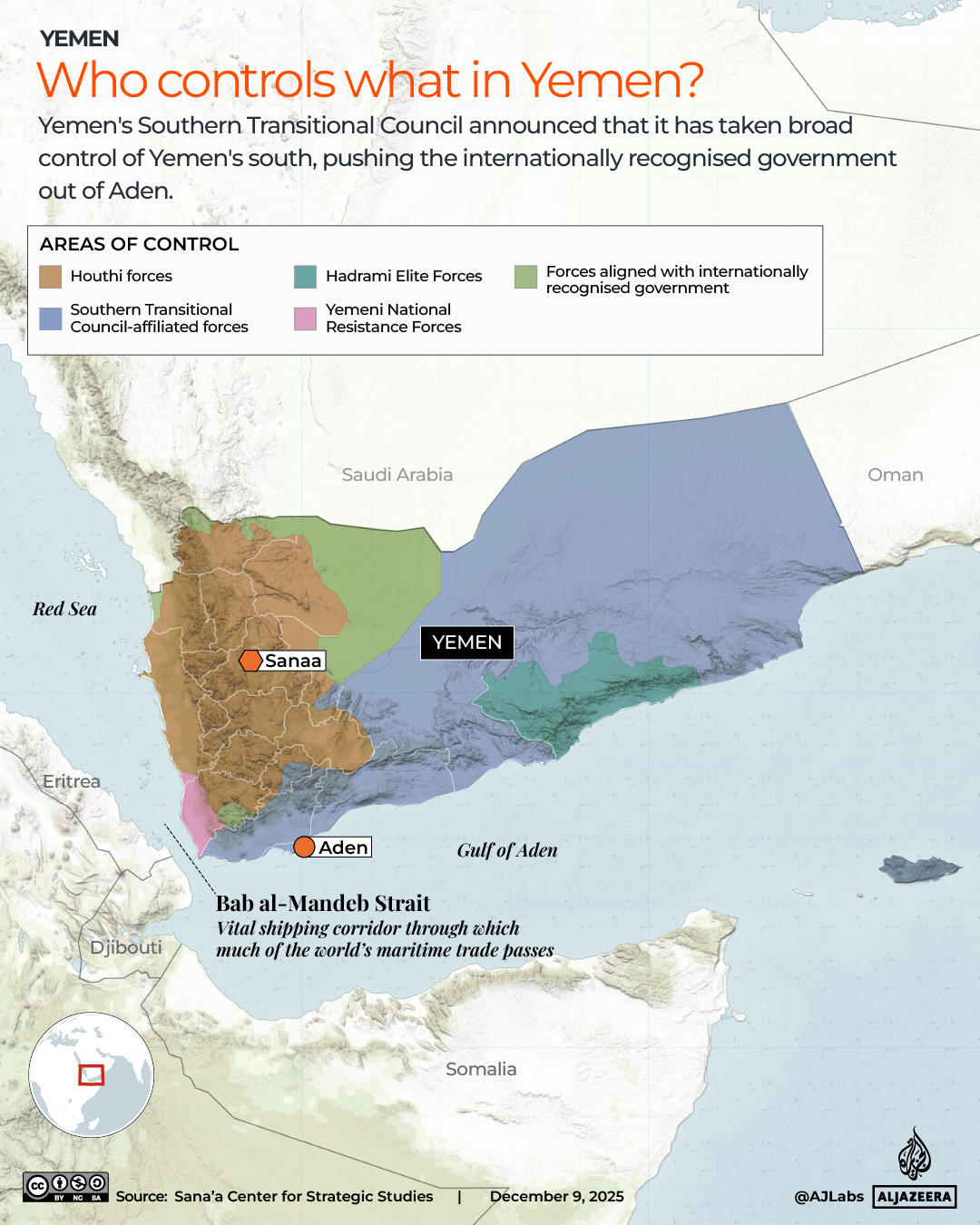
The STC, which initially supported Yemen’s internationally recognised government against the Houthi rebels who control northern Yemen, launched an offensive against Saudi-backed government troops in December, seeking an independent state in the south.
Their advance aimed to control broad swaths of southern Yemen, including the Hadramout and Mahra provinces, in defiance of warnings from Riyadh.
Hadramout borders Saudi Arabia, while Mahra is close to the border. Together, the provinces make up nearly half of Yemeni territory.
Riyadh responded with air strikes on the Yemeni port of Mukalla on December 30, targeting what it called a UAE-linked weapons shipment, and backed a call by the internationally recognised government for Emirati forces to withdraw from the country.
Abu Dhabi denied that the shipment contained weapons and expressed a commitment to ensure Riyadh’s security. Shortly afterwards, it announced an end to what it called its “counterterrorism mission” in Yemen.
Yemeni government troops, backed by Saudi Arabian air attacks, went on to reclaim Hadramout and Mahra, and the STC said on Saturday it would attend peace talks hosted by Saudi Arabia.
