Trump says no more Venezuelan oil or money to go to Cuba, demands ‘deal’
Venezuela is Cuba’s biggest oil supplier, but no shipments have departed Venezuelan ports since Maduro’s abduction.
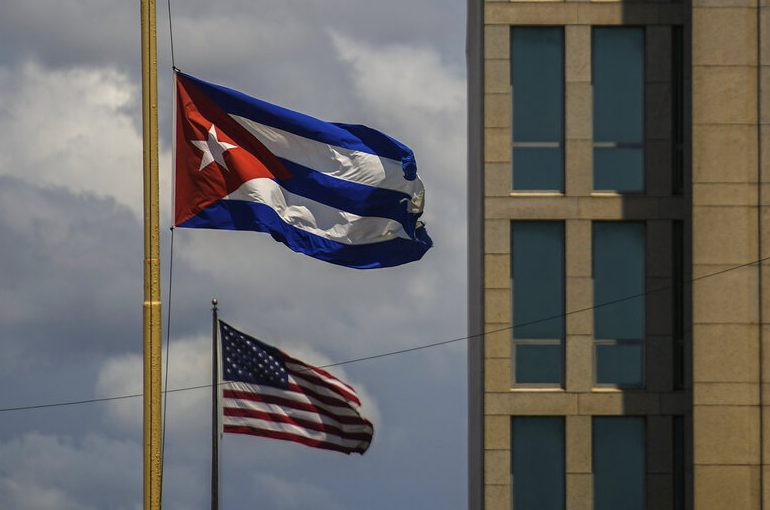
United States President Donald Trump says no more Venezuelan oil or money will go to Cuba, and he has suggested that the communist-run island should strike a deal with Washington, ramping up pressure on the longtime US nemesis.
Venezuela is Cuba’s biggest oil supplier, but no cargo has departed from Venezuelan ports to the Caribbean country since US forces abducted Venezuelan President Nicolas Maduro on January 3, amid a strict US oil blockade on the OPEC country, according to the latest shipping data.
Recommended Stories
list of 3 items- list 1 of 3Trump promises oil executives ‘total safety’ if they invest in Venezuela
- list 2 of 3Analysis: Why Venezuela’s military holds the key to country’s future
- list 3 of 3Trump meets US oil bosses to discuss Venezuela extraction
“THERE WILL BE NO MORE OIL OR MONEY GOING TO CUBA – ZERO! I strongly suggest they make a deal, BEFORE IT IS TOO LATE,” Trump wrote on his Truth Social platform on Sunday.
“Cuba lived, for many years, on large amounts of OIL and MONEY from Venezuela,” Trump added.
Trump did not elaborate on his suggested deal, but US officials have hardened their rhetoric against Cuba in recent weeks.
Earlier on Sunday, Trump also reposted a message on Truth Social suggesting US Secretary of State Marco Rubio could become the president of communist-governed Cuba.
Trump shared the post with the comment: “Sounds good to me!”
Cuban President Miguel Diaz-Canel rejected Trump’s threats in a post on X.
“Cuba is a free, independent, and sovereign nation. Nobody dictates what we do,” Diaz-Canel said.
“Cuba does not attack; it has been attacked by the US for 66 years, and it does not threaten; it prepares, ready to defend the homeland to the last drop of blood.”
Earlier, Cuban Minister of Foreign Affairs Bruno Rodriguez insisted that “right and justice are on Cuba’s side”.
The US “behaves like an out-of-control criminal hegemon that threatens peace and security, not only in Cuba and this hemisphere, but throughout the entire world”, Rodriguez posted on X.
Rodriguez also said in a separate post on X that Cuba had the right to import fuel from any suppliers willing to export it. He denied that Cuba had received financial or other “material” compensation in return for security services provided to any country.
Under a US trade embargo, Havana has since 2000 increasingly relied on Venezuelan oil provided as part of a deal struck with Maduro’s predecessor, Hugo Chavez.
As its operational refining capacity dwindled in recent years, Venezuela’s supply of crude and fuel to Cuba has fallen. But the South American country is still the largest provider, with about 26,500 barrels per day exported last year, according to ship-tracking data and internal documents of Venezuela’s state-run oil company, PDVSA.
Venezuela’s shipments covered roughly 50 percent of Cuba’s oil deficit. Cuba also relies on imported crude and fuel provided by Mexico in smaller volumes.
Mexican President Claudia Sheinbaum said last week that her country had not increased supply volumes, but, given recent political events in Venezuela, Mexico had turned into an “important supplier” of crude to Cuba.
Al Jazeera’s Alessandro Rampietti, reporting from Cucuta in Colombia, said that, despite its defiant rhetoric, Cuba may struggle to find alternative sources of fuel.
“The country is also going through one of the worst economic crises in recent years, probably the worst since the 1990s, after the fall of the Soviet Union. Life has become very hard for regular Cubans on an everyday basis, with rolling blackouts, shortages. Agricultural output has been failing. Tourism is down also,” Rampietti said.
He added that the US cutting off the supply of Venezuelan oil could worsen an already “difficult situation” in Cuba.
“We also heard this week that at least two of the warships of the US Navy have moved from the Caribbean to the Atlantic, closer to Cuba. So, a lot of pressure on the country. We’re going to have to see if they will be able to withstand even this latest US threat,” Rampietti said.
In Cuba, some residents expressed defiance, while others said the country will be affected by the loss of Venezuelan oil.
Maria Elena Sabina said the government of Diaz-Canel needed to make a decision quickly, “because it is the people who are suffering”.
“There’s no electricity here, there’s no power here, there’s no gas here, no liquefied gas,” she said. “So yes, change is needed, change is needed, but quickly, hopefully tomorrow.”
Another Havana resident, Luis Alberto Jimenez, said he was not afraid of Trump’s warnings.
“At no point, at no point does that scare me, because I’m prepared. The Cuban people are prepared for anything, any situation that may arise, for everything. We are prepared for that,” he said.
Eli Bremer, a Republican strategist, told Al Jazeera that Trump and US Secretary of State Marco Rubio have made it clear they want change in Cuba.
“Cuba is sort of a thorn in the side of the United States. It’s about 90 miles [145km] off the coast of Florida. It has constantly allied itself with the US’s enemies, [like] it’s the Soviet Union, and they have tighter relationships with China and with Venezuela,” Bremer said.
“So I think, at a minimum, he expects them not to be partnered up with the US enemies. But despite the fact that Trump said that he will not pursue regime change, I think it is abundantly clear that he would like to see a free Cuba that could become a trading partner and ally of the United States,” he added.
In Washington, DC, Al Jazeera’s Patty Culhane said that despite Trump’s threats to Cuba, Americans generally want the US president to focus on the domestic economy.
“There is an affordability crisis in this country: groceries are expensive, housing is expensive, health insurance has gone up,” she said, reporting from Washington, DC.
“This is a president who has said he will focus on America First. We have now seen him bomb seven countries… so within [Trump’s] base, they are starting to see cracks, because this is not what he promised on his campaign trail,” she added.
