Huge crowds for Khaleda funeral as Bangladesh bids farewell to ex-leader
Mourners surround Bangladesh’s parliament in Dhaka to pay their respects to the country’s first female prime minister.
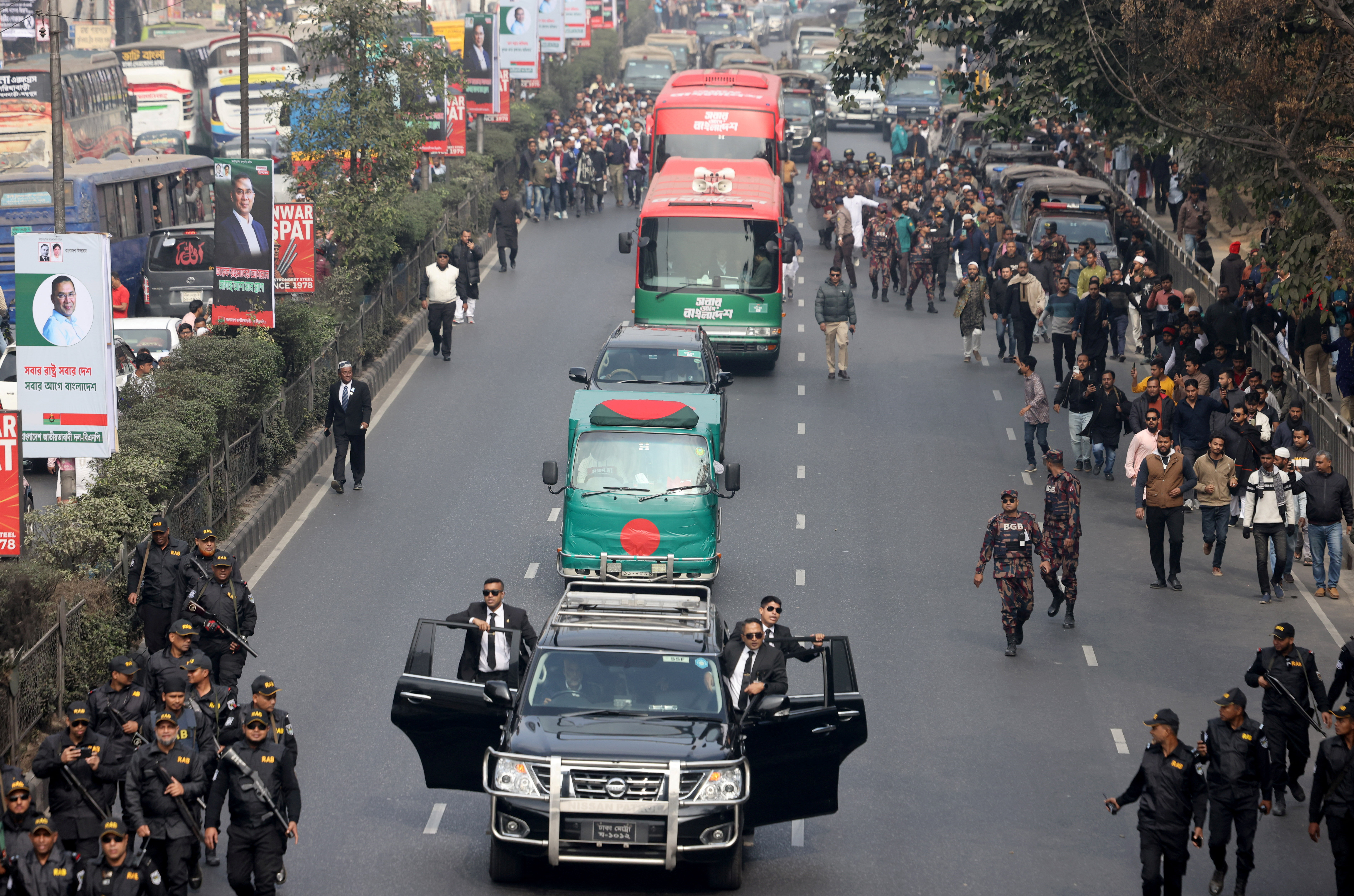
Vast crowds have gathered in the Bangladeshi capital Dhaka for the state funeral of former Prime Minister Khaleda Zia, with mourners travelling from across the country to bid farewell to a towering political leader.
Footage showed huge crowds streaming in towards the national parliament building on Manik Mia Avenue, where her coffin, draped in the national flag, was taken in a convoy on Wednesday. About 10,000 security personnel lined the streets to maintain order, officials said.
Zia’s body was then interred alongside her late husband, Ziaur Rahman, who was assassinated in 1981 during his time as president. Leaders and military officials laid wreaths as the burial took place.
Zia, the first woman to serve as prime minister in the South Asian nation when she became premier in 1991, died on Tuesday aged 79, after a prolonged illness.
Bangladesh has declared three days of state mourning, while tributes have flowed from world leaders as mourners farewell a politician viewed as a figurehead of the country’s democratic movement.
‘An entire nation is grieving’
Reporting from outside parliament in Dhaka, Al Jazeera’s Tanvir Chowdhury said emotions were high among the huge crowds gathered for the state funeral.
“Many people are weeping,” he said.
“People were coming from all across the country to gather here. They said we have to come … to show that she will be missed.”
Mourners had described her as “a great leader for this country”, saying she had “shown us the way to democracy”, he said.
“An entire nation is grieving,” he added.
One mourner, Sharmina Siraj, told the AFP news agency that Zia was “an inspiration”, saying it was “difficult to imagine women in leadership positions anytime soon”.
Siraj, a 40-year-old mother of two, said stipends introduced by Zia to support girls’ education “had a huge impact on the lives of our girls”.
Watching from behind a barbed wire barricade as Zia’s body passed by, retired government official Minhaz Uddin told AFP that while he had never voted for her, he came to honour the former leader.
“I came here with my grandson, just to say goodbye to a veteran politician whose contributions will always be remembered,” he said.

‘A guiding presence’
Zia’s son Tarique Rahman, who returned to Bangladesh on Thursday after 17 years in self-imposed exile in the UK, said in a statement that the country was mourning “the loss of a guiding presence that shaped its democratic aspirations”.
His mother, he said, had “endured repeated arrests, denial of medical care, and relentless persecution”, but “her resilience … was unbreakable”.
Rahman, the acting chairman of Khaleda’s Bangladesh Nationalist Party, “will possibly be the next prime minister” if his party wins the elections in February, Chowdhury said.
India’s government said Foreign Minister Subrahmanyam Jaishankar attended the funeral, in the most senior visit by an Indian official to Bangladesh since the overthrow of former Prime Minister Sheikh Hasina, Zia’s great political rival.
He said he had met with Rahman and offered India’s “deepest condolences”.
Hasina, 78, has lived in exile in India since was ousted amid mass protests last year, and was sentenced to death in absentia by a special tribunal in Dhaka in November for crimes against humanity during the deadly crackdown she ordered that killed hundreds of protesters.
In a statement shared on social media by her now-banned Awami League party, Hasina said she prayed “for the eternal peace and forgiveness of Begum Khaleda Zia’s soul”.
Zia was jailed for corruption in 2018 under Hasina’s government, which also blocked her from travelling abroad for medical treatment.
Zia was released in 2024, shortly after Hasina was forced from power.
Despite years of poor health and imprisonment, Zia had vowed to campaign in the February elections, the country’s first vote since the uprising that toppled Hasina.
