China launches drills around Taiwan in ‘stern warning’ to external forces
China’s military carries out live firing around Taiwan, says continued drills on Tuesday will simulate blockade of island’s main ports.
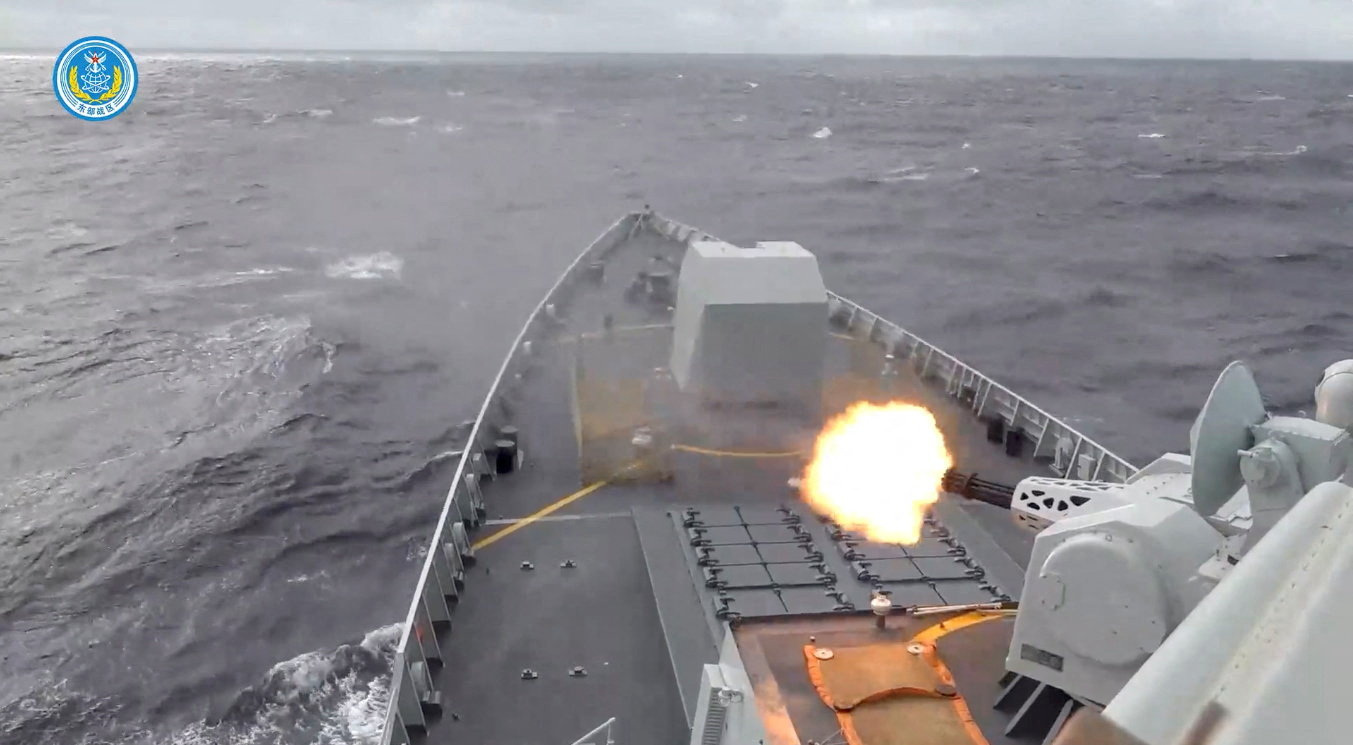


China has launched live-fire drills around Taiwan, deploying air, navy and rocket troops for war games that its military said were aimed at testing combat readiness and delivering a “stern warning” against “separatist” and “external interference” forces.
Taiwan on Monday detected at least 14 Chinese naval vessels, 14 coast guard ships and 89 aircrafts, 67 of which entered Taiwan’s response zones, officials said in an afternoon press briefing.
Recommended Stories
list of 3 items- list 1 of 3US sells $700m NASAMS missile system to Taiwan
- list 2 of 3US approves $11bn in arms sales to Taiwan in deal likely to anger China
- list 3 of 3Beijing’s reaction to US-Taiwan arms deal is “information warfare”
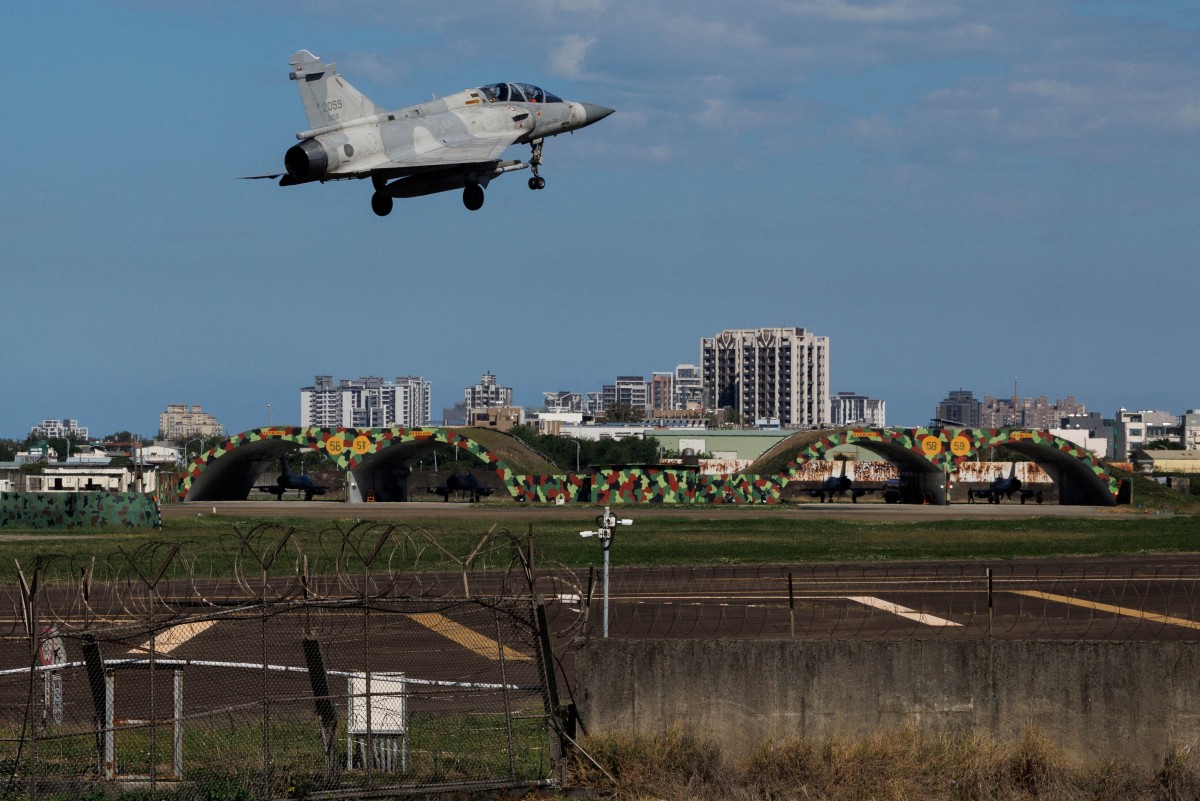
The exercises prompted Taiwan to scramble soldiers and hardware to rehearse repelling an attack, while also forcing the diversion of commercial flights.
More than 100,000 passengers on scheduled international flights and about 6,000 domestic air passengers were estimated to be impacted by the diversions Tuesday, Taiwan’s transport ministry said.
Port authorities said there were no expected effects on commercial ships travelling in and out of Taiwanese ports, but warned ships to avoid Chinese drill zones.
The drills came amid anger in Beijing over an $11.1bn weapons sale to Taiwan by the United States, as well as a statement by Japanese Prime Minister Sanae Takaichi, who suggested that the Japanese military could get involved if China were to attack the self-governed island.
Beijing considers Taiwan as part of its territory and has pledged to take control of the island by force if necessary.
In a regular news briefing on Monday, China’s Foreign Ministry spokesperson Lin Jian warned that “any sinister schemes to obstruct China’s reunification are doomed to fail”.
“External forces attempting to use Taiwan to contain China and arm Taiwan will only embolden pro-independence arrogance and push the Taiwan Strait into a perilous situation of imminent war,” Lin said.
Lin also claimed that pro-independence forces in Taiwan were willing to turn the island into a “powder keg”, thus “exposing their vicious nature”.
The Chinese military’s Eastern Theater Command previously said it had concentrated forces to the north and southwest of the Taiwan Strait and carried out live firing and simulated strikes on land and maritime targets.
The drills, dubbed Just Mission 2025, would continue on Tuesday and include exercises to blockade the island’s main ports and encircle it.
Shi Yi, a spokesperson for the Eastern Theater Command, wrote on Chinese social media platform Weibo that the drills serve “as a serious warning to ‘Taiwan Independence’ separatist forces and external interference forces”.
Al Jazeera’s Katrina Yu reported from Beijing that China considers the recent moves from the US and Japan to be “provocations”.
Chinese officials have promised “time and time again that any interference in its mission to retake Taiwan … would be crossing China’s red line”, she added.
Sixth major round of drills
Taiwan’s government and residents condemned the drills.
A presidential office spokesperson urged China not to misjudge the situation and undermine regional peace, and called on Beijing to immediately halt what they described as irresponsible provocations.
Minister of Transportation Chen Shih-kai told reporters “we strongly protest and condemn their arrogant and unreasonable actions, which will inevitably affect the safety of our air and sea transportation”.
Taiwan’s defence ministry said two Chinese military aircraft and 11 ships had been operating around the island over the last 24 hours, and that the island’s military was on high alert and poised to carry out “rapid response exercises”.
That particular drill is designed to move troops swiftly in case China suddenly turns one of its frequent drills around the island into an attack.
“All members of our armed forces will remain highly vigilant and fully on guard, taking concrete action to defend the values of democracy and freedom,” it said in a statement.
The ministry also posted a video on Facebook showcasing various weapons, including US-made HIMARS rocket systems, a highly mobile artillery system with a range of about 300km (186 miles) that could hit coastal targets in China’s southern province of Fujian, on the other side of the Taiwan Strait, in the event of a conflict.
Taiwan’s coastguard added that it had dispatched large ships in reaction to Chinese coastguard activity near its waters and that it was working with the island’s military to minimise the drills’ impact on maritime routes and fishing areas.
The island’s aviation authority said China had designated a “temporary danger zone” in Taipei’s airspace for 10 hours of live-fire drills scheduled for Tuesday and that it was working to identify alternative flight routes.
Taiwanese residents reacting to the drills on Monday told Al Jazeera that they believed China intended to intimidate them.
“China’s goal is to keep the island, not the people,” said Stephanie Huang, an interior designer. “But Taiwanese people don’t see it that way – we are who we are, and they are who they are. The two sides of the Strait are completely insubordinate to each other. We are our own country.”
Lin Wei-Ming, a teacher, said the drills “are just meant to scare us”.
“As ordinary citizens, all we can do is take care of ourselves, do our jobs well and live our lives well,” he added.
‘Strong signal’ to US, Japan
The drills mark China’s sixth major round of war games since 2022 – after then-US House of Representatives Speaker Nancy Pelosi visited Taiwan – and were described by the state-owned Xinhua news agency as “a legitimate and necessary action to safeguard China’s sovereignty and national unity”.
The People’s Liberation Army (PLA) said it had deployed fighter jets, bombers, unmanned aerial vehicles, and long-range rockets, and would practise striking mobile land-based targets.
Chinese vessels and aircraft will approach Taiwan “in close proximity from different directions” and troops of multiple services will “engage in joint assaults to test their joint operations capabilities”, according to Shi.
China’s state broadcaster added that the drills would focus on sealing off Taiwan’s vital deep-water Port of Keelung to the island’s north and Kaohsiung to Taiwan’s south, the island’s largest port city.
While the Chinese military has practised port blockades around Taiwan during war games last year, this marks the first time it has publicly stated that drills around the island are aimed at deterring foreign military intervention, according to observers.
“The language is now very explicit about the goal of enhancing ‘anti-access’ and ‘area denial capabilities,'” said William Yang, senior analyst for Northeast Asia at the Crisis Group.
He told Al Jazeera the language was a “very strong signal” to Taiwan’s unofficial allies like the US and Japan that they would be blocked from offering external assistance during a conflict.
The “Just Mission 2025” exercises also cover a notably larger zone around Taiwan than previous iterations, Yang said, and demonstrate that the PLA has upgraded its ability to swiftly deploy many different military assets to strategically important positions in a short window of time.
“This is a very real demonstration of the progress of the PLA’s modernisation,” he said.
The Chinese exercises come after the US announced earlier this month that it had approved $11.1bn in arms sales to Taiwan in the largest ever weapons package for the island.
The move drew a protest from China’s defence ministry and warnings that the military would “take forceful measures” in response.
Beijing last week also imposed sanctions against 20 US defence -related companies and 10 executives over the move.
The remarks from Takaichi, the Japanese prime minister, have also triggered a surge in Chinese messaging stressing its sovereignty claims. Chinese President Xi Jinping told his US counterpart, Donald Trump, in November that Taiwan’s “return to China” after World War II was central to Beijing’s vision of the global order.
Taiwan rejects China’s claimed sovereignty, maintaining that only its people can decide the island’s future.
In an interview broadcast on Sunday, Taiwanese President William Lai Ching-te told Sanli E-Television that the island must continue to raise the cost of aggression and strengthen its indigenous defence capabilities to deter China, stressing that peace can only be secured through strength.
“If China sets 2027 as the year to be ready for an invasion of Taiwan, then we have only one choice: to keep raising the difficulty so that China can never meet that standard. Taiwan will naturally remain safe,” Lai said.
