Syria’s government curbing once-booming Captagon industry: UN report
Authorities have shuttered drug factories that were cash pipeline for former ruler Bashar al-Assad, UN report.
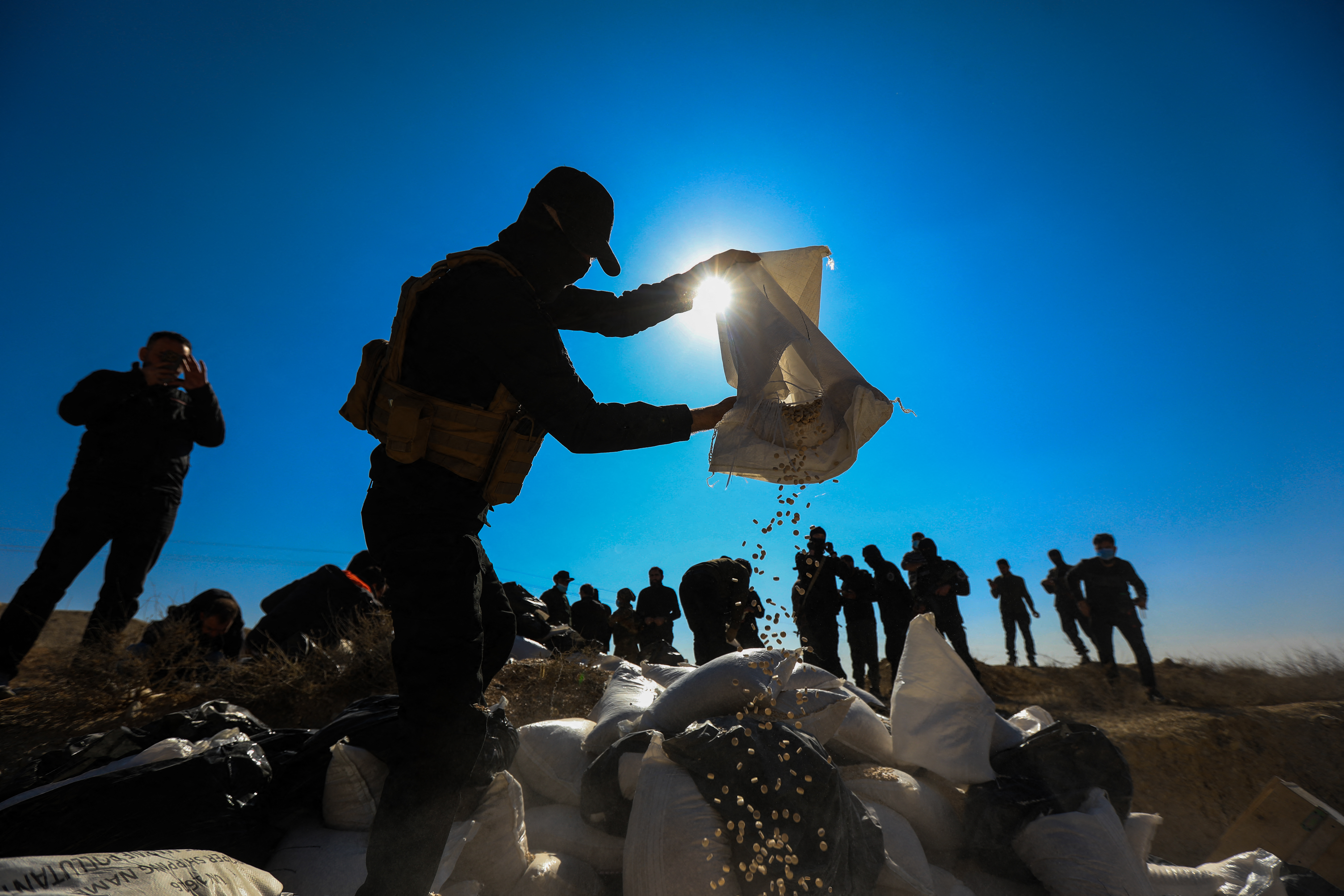
Syria’s government has cracked down on the Captagon industry, which boomed under former longtime leader Bashar al-Assad, according to a United Nations report.
Since al-Assad’s ouster a year ago, Syria’s new authorities have dismantled a network of factories and storage sites, a research brief published on Monday by the UN Office on Drugs and Crime (UNODC) said.
Recommended Stories
list of 3 items- list 1 of 3Israel launches new raids in Syria’s Quneitra, establishes checkpoints
- list 2 of 3US aerial bombardment strikes ‘ISIS thugs’ in Syria
- list 3 of 3Post‑Assad Syria’s security challenges persist despite political change
For more than a decade, Syria produced most of the world’s Captagon, a highly addictive, amphetamine-like pill, bringing in billions of dollars for al-Assad’s government.
However, interim President Ahmed al-Sharaa has carried out a clampdown as he tries to legitimise his government and strengthen diplomatic ties globally.
Overall, 15 industrial-level laboratories and 13 storage sites have been shuttered, according to the UNODC report. The agency said the action has “drastically changed” the Captagon market across the region.
Syria’s role in the drug trade had previously drawn scrutiny from numerous Gulf states, where the pill is popular, including Saudi Arabia. It also helped to prompt Western sanctions.
‘Political will and international cooperation’
For years, the Captagon trade provided billions of dollars in profit for networks and individuals aligned with the former government “either within the leadership of the regime’s security apparatus, Syria’s commercial sector and business elite, and/or family members of Bashar al-Assad”, according to Caroline Rose, an expert on Syrian drug trafficking at the New Lines Institute think tank.
Maher al-Assad, Bashar’s brother and former commander of the army’s elite Fourth Division, was identified as a key player, profiting from protecting shipments through Latakia, a former al-Assad stronghold.
Despite the current Syrian government’s targeting of the industry, large seizures of the drug across the region suggest that significant stockpiles of the pills originating from Syria remain in circulation, the report noted.
Smaller-scale production is also likely continuing inside Syria and in neighbouring countries, the UNODC added, with Gulf countries still the top buyers of the drug.
The UN agency said the disruption of the Middle East’s Captagon industry shows that with “political will and international cooperation … even highly complex drug markets can be destabilised within a relatively short period of time”.
However, it warned that the shift risks pushing regional consumers towards new synthetic substances, like methamphetamine, which has recently grown in popularity.
“Without addressing the underlying demand for ‘Captagon,’ trafficking and use are likely to shift toward other substances, such as methamphetamine, with new routes and actors emerging to fill the gap,” it said.
