Hegseth or Admiral Bradley: Who approved the second Venezuela boat strike?
The US defence secretary and White House have defended the second strike, but Trump has said he would not have wanted it.
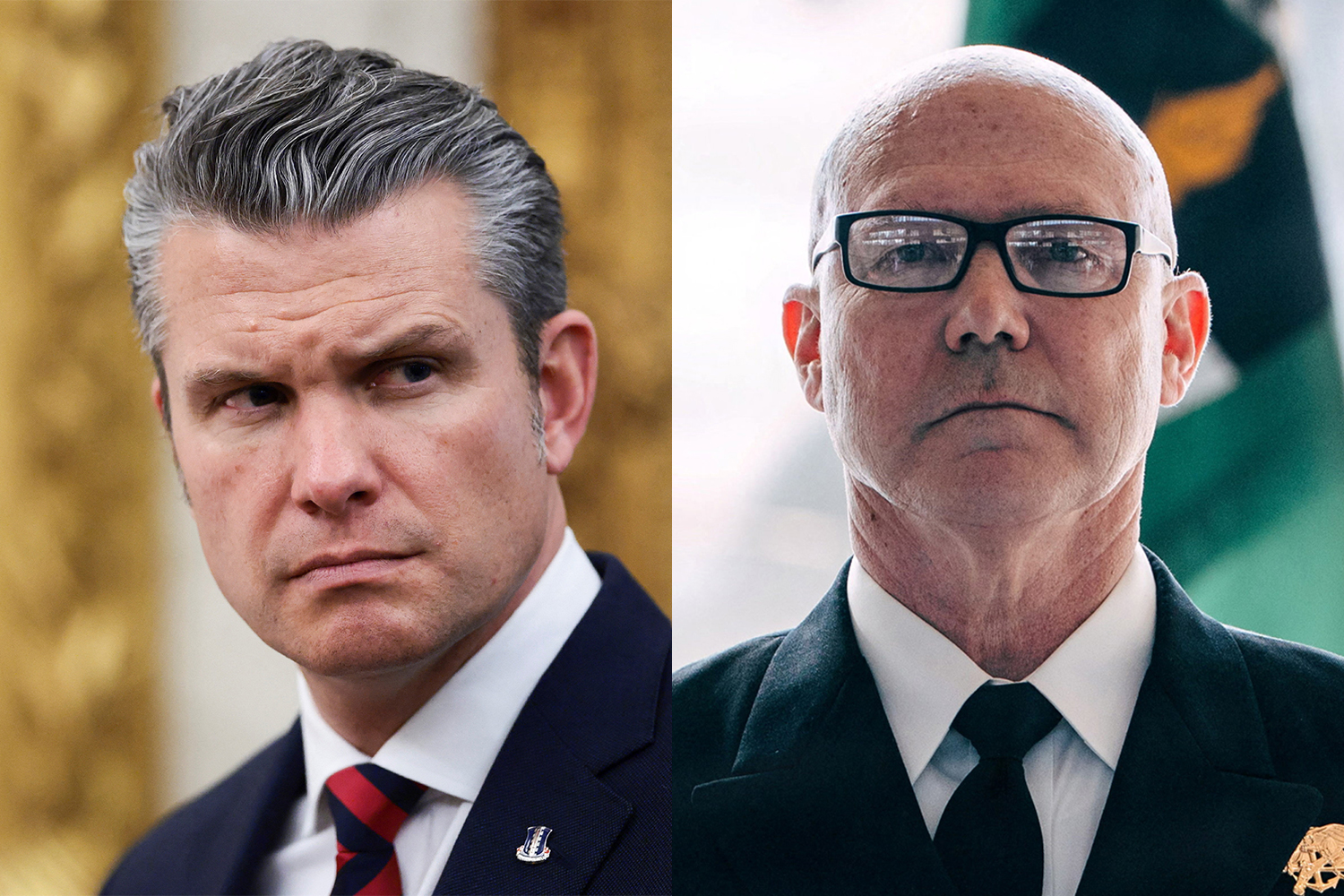

United States President Donald Trump’s administration is facing a political and legal firestorm over reports that its military carried out a second strike on a boat in the Caribbean Sea, which Washington claims was carrying drugs, after two people survived the initial attack.
At the heart of the controversy are two questions: Who ordered the second strike on the boat in September, and was it legal?
Recommended Stories
list of 3 items- list 1 of 3Is US President Donald Trump preparing to strike Venezuela?
- list 2 of 3Al Jazeera reports from reopened US base as Venezuela tensions rise
- list 3 of 3Maduro rejects a ‘slave’s peace’ for Venezuela as US ramps up pressure
Here’s what we know:
What happened?
On September 2, 2025, the US military struck a boat in the Caribbean during Operation Southern Spear, a major campaign that the Trump administration claims is aimed at dismantling drug-trafficking networks.
The first strike destroyed the vessel and killed nine people. Two survivors were left clinging to the debris.
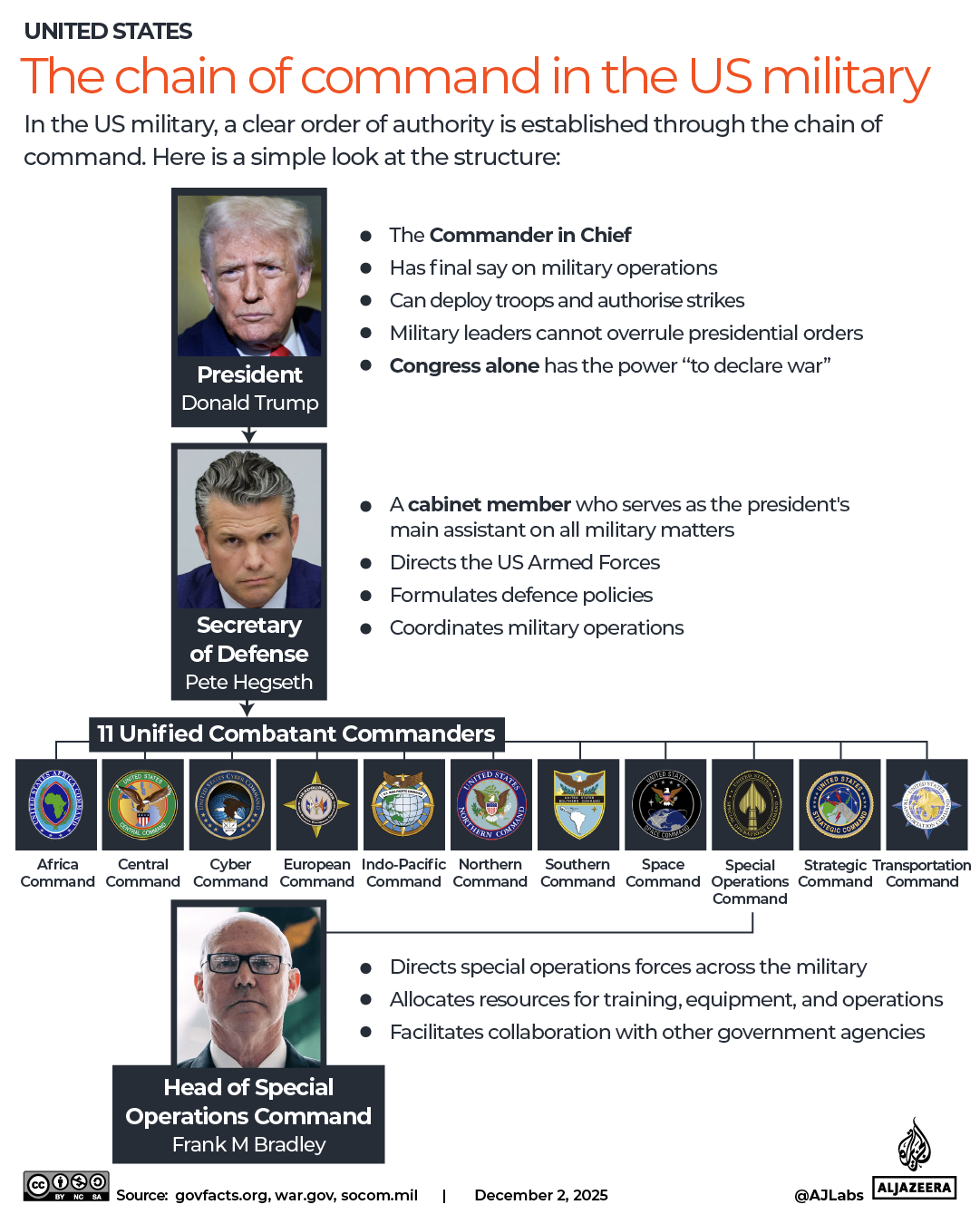
According to The Washington Post, Secretary of Defense Pete Hegseth gave a verbal instruction, which its reporting described as an order “to kill everybody”.
The mission’s commander, Admiral Frank Bradley, then ordered a second strike, which killed the two survivors.
The September 2 attack kick-started a broader US operation in the Caribbean Sea and the Pacific Ocean, in which more than 80 people have been killed in strikes on more than 20 boats. Experts have called these attacks illegal under international law.
But the second strike on September 2, what in military jargon is known as a “double-tap” attack, has drawn particular scrutiny as some experts have called it a likely war crime.
The strike has drawn criticism not just from Democrats but from several Republicans in Congress, who have pledged to lead investigations into what happened.
The Republican-led Senate Armed Services Committee announced on Friday that it planned to conduct an “oversight” of the strikes.
“The Committee is aware of recent news reports – and the Department of Defense’s initial response – regarding alleged follow-on strikes on suspected narcotics vessels in the SOUTHCOM area of responsibility,” the committee’s chairs, Republican Senator Roger Wicker and Democratic Senator Jack Reed, said in a statement.
“The Committee has directed inquiries to the Department, and we will be conducting vigorous oversight to determine the facts related to these circumstances,” they said.
The House of Representatives Armed Services Committee, separately, said it was seeking “a full accounting of the operation in question”.
Congressional committees have sought audio recordings and other evidence to piece together how the order was given.
What has Pete Hegseth said?
Hegseth called the report “fake news” on social media, saying the boat strikes were “in compliance with the law of armed conflict – and approved by the best military and civilian lawyers, up and down the chain of command”.
But he also appeared to justify the double-strike.
“The declared intent is to stop lethal drugs, destroy narco-boats, and kill the narco-terrorists who are poisoning the American people,” Hegseth said in a social media post on Friday evening. “Every trafficker we kill is affiliated with a Designated Terrorist Organization.”
On Tuesday, at a Cabinet meeting where he was seated next to Trump, Hegseth said that while he had watched the first September 2 strike in real-time, he had not seen the survivors of the attack before the second strike was carried out. He described the situation as an example of the “fog of war”.
Earlier this year, the Trump administration formally labelled the Venezuelan gang Tren de Aragua a terrorist group. It also accused Venezuela’s president, Nicolas Maduro, of leading the Cartel de los Soles, which US officials describe as a drug-smuggling network involving senior figures in the country’s government and armed forces.
In reality, the Cartel de los Solos is not a cartel, but just a broad term used by Venezuelans for corrupt senior officials. And the US administration’s own Drug Enforcement Agency lists other countries, not Venezuela, as the major sources of narcotics entering the US.
While Trump has repeatedly claimed that Tren de Aragua is a front for Maduro, his own intelligence agencies have concluded that there is no link between the gang and the Venezuelan president.
Have Trump and the White House contradicted each other?
Answering questions on Air Force One on Sunday, Trump said his administration “will look into” the reports of the second strike on the boat on September 2.
But he added, “I wouldn’t have wanted that – not a second strike.”
He noted that Hegseth told him that “he did not order the death of those two men”.
In the nearly two dozen subsequent strikes by the US military on boats, US troops have, in several cases, helped rescue survivors and then repatriated them to the countries they belong to.
However, in contrast to Trump’s statement, White House Press Secretary Karoline Leavitt echoed Hegseth in justifying the second strike on September 2.
“The strike conducted on September 2 was conducted in self-defence to protect Americans and vital United States interests. The strike was conducted in international waters and in accordance with the law of armed conflict,” she said in response to a question from a reporter on Monday evening.
So who approved the strike?
According to the White House, Hegseth authorised Admiral Bradley to carry out the September 2 “strikes”, suggesting that the defence secretary gave the mission commander the go-ahead to carry out multiple attacks on the boat if needed.
“Secretary Hegseth authorised Admiral Bradley to conduct these kinetic strikes,” Leavitt told a media briefing on Monday.
But the actual decision to carry out the second strike was Bradley’s, Leavitt said.
“Admiral Bradley worked well within his authority and the law. He directed the engagement to ensure the boat was destroyed and the threat of narco-terrorists to the United States was completely eliminated,” she said.
![US Navy Admiral Frank ‘Mitch’ Bradley, incoming commander of the US Special Operations Command, delivers remarks during the USSOCOM Change of Command Ceremony in Tampa, Florida, US, October 3, 2025 [Reuters]](/wp-content/uploads/2025/12/2025-12-02T010334Z_703644065_RC2I4HAVINU9_RTRMADP_3_USA-TRUMP-VENEZUELA-STRIKE-1764648541.jpg?w=770&resize=770%2C513&quality=80)
Why the question of who ordered it matters
According to experts, a second strike killing survivors was illegal.
“Instead of having due process and a criminal prosecution, the Trump administration has decided to be judge, jury and executioner, and on their own claim that these individuals are carrying drugs, ordering them killed, which is extrajudicial killing, which is murder,” Rachel VanLandingham, a military expert at Southwestern Law School, told Al Jazeera.
“That second strike against individuals who are shipwrecked, clinging desperately to the side of their boat wreckage – that’s a war crime. It’s a war crime because those individuals who are shipwrecked have protected status under the law, unless they were, for example, shooting a gun at somebody. But, otherwise, they’re protected,” she added.
Legally, the US can only use force if there is a real threat, so identifying the decision-maker is key to judging whether the strike followed the rules, experts have said.
