Behind Trump’s threat: Why is Greenland so strategically important?
The US president has not ruled out using military power to take over the Danish territory – home to a US military base.

Trump's threats to control Greenland: EU says it won't allow attacks on 'sovereign borders'

The White House on Monday said that United States President Donald Trump was exploring all options available to Washington to acquire Greenland, after he raised the demand for the territory again following the abduction of Venezuelan President Nicolas Maduro on January 3.
It said military means were also on the table as a possible way for the US to annex the giant island.
Recommended Stories
list of 4 items- list 1 of 4Panama commemorates canal handover despite Trump’s call for US control
- list 2 of 4Danish PM says Greenland ‘not for sale’ as Donald Trump Jr visits island
- list 3 of 4‘Hell will break out’: Trump hints at military moves in Mideast, Americas
- list 4 of 4NATO, Gaza and Greenland: Key takeaways from Trump’s news conference
“The president and his team are discussing a range of options to pursue this important foreign policy goal, and of course, utilizing the US military is always an option at the commander-in-chief’s disposal,” it said.
Trump has repeatedly said — since his first term in office — that he wants Greenland, an autonomous Danish territory, as a part of the US, citing the territory as critical to American national security.
His demands have led to pushback from Greenland, Denmark and the European Union, but none of that has deterred Trump.
So why does Trump want to acquire Greenland — a territory that is 80 percent covered in snow and is more than 3,000km (1,864 miles) from the US capital, Washington, DC? Is this the first time that the US has tried to acquire Greenland?
Where is Greenland?
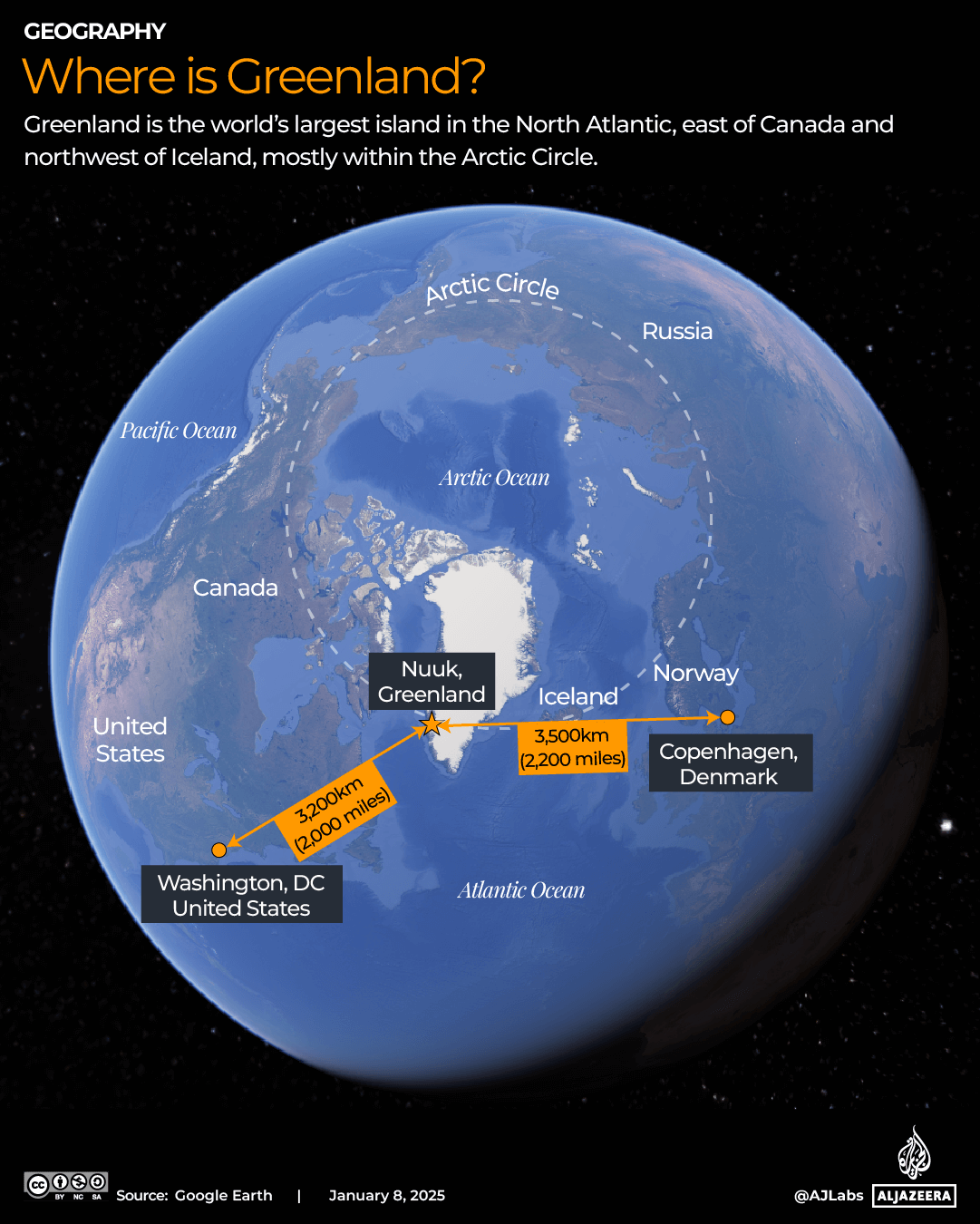
Located between the Arctic Ocean and the North Atlantic Ocean, Greenland is the world’s largest island and geographically part of North America. Though Australia is much larger and is surrounded by water, it isn’t considered an island because it’s a continent.
Greenland is home to some 56,000 residents, mostly Indigenous Inuit people.
Its capital, Nuuk, is closer to New York (some 2,900km or 1,800 miles) than Copenhagen, which is located 3,500km (2,174 miles) to the east.
When did Greenland become part of Denmark?
The island became a Danish colony in the early 18th century, after an expedition led by Danish-Norwegian missionary Hans Egede arrived in 1721.
In 1979, it became a self-governing territory. Since 2009, Greenland has the right to declare independence through a referendum.
The Arctic island is one of Denmark’s two autonomous territories, the other one being the Faroe Islands.
Since Denmark is a part of NATO, Greenland is by default a part of the North Atlantic military alliance.
Greenland is not a member state of the European Union, but is associated with it as one of the 25 EU overseas countries and territories (OCTs). “OCT nationals are EU citizens,” an EU law website says. Hence, Greenlanders are considered to be EU citizens.
In 1973, Greenland joined the now-defunct European Community with Denmark, but left in 1985. The EU has replaced the European Community.
How have Greenland and Denmark reacted to Trump’s threats?
The leaders of Denmark and Greenland have repeatedly rejected Trump’s claims on the territory.
On Monday, Danish Prime Minister Mette Frederiksen said that an American takeover of Greenland would effectively kill the NATO military alliance.
Greenland Prime Minister Jens-Frederik Nielsen was firm in his pushback, too.
“We have been the USA’s close and loyal friend for generations,” Nielson said on Facebook. “That is why the current and recent rhetoric from the US is completely unacceptable.”
“When the US president says that ‘We need Greenland’ and links us to Venezuela and military intervention, it is not just wrong. It’s disrespectful,” Nielsen added.
In January 2025, when Trump made similar threats just before he took over as president, the Danish government announced it would boost defence spending in Greenland to the tune of $1.5bn.
“Greenland, as an autonomous territory within the Kingdom of Denmark, enjoys sovereignty under the Rigsfællesskabet framework, and any military intervention would constitute a direct violation of its rights as well as Denmark’s,” Christine Nissen, the chief analyst at the Copenhagen-based Think Tank Europa, told Al Jazeera.
“Denmark and the EU are navigating a challenging balancing act: they must underscore the seriousness of being threatened on such a fundamental principle as sovereignty while striving to maintain a constructive relationship with the United States, a key transatlantic partner.
“This situation requires strategic diplomacy, combining firm boundaries with efforts to de-escalate tensions and safeguard broader cooperative interests,” she said.
Why does Trump want Greenland?
Trump has repeatedly expressed a desire to take control of the island, which hosts a US military base.
Greenland offers the shortest route from North America to Europe. This gives the US a strategic upper hand for its military and its ballistic missile early-warning system.
The US has expressed interest in expanding its military presence in Greenland by placing radars in the waters connecting Greenland, Iceland and the United Kingdom. These waters are a gateway for Russian and Chinese vessels, which Washington aims to track.
The island is also incredibly rich in minerals, including rare earth minerals used in the manufacture of batteries and high-tech industry.
According to a 2023 survey, 25 of 34 minerals deemed “critical raw materials” by the European Commission were found in Greenland.
Greenland does not carry out the extraction of oil and gas, and its mining sector is opposed by its Indigenous population. The island’s economy is largely reliant on its fishing industry.
Has the US tried to buy Greenland before?
Yes. The US has long expressed an interest in Greenland.
The US has considered purchasing Greenland at least twice, including in 1867 and in 1946.
In 1867, the US bought Alaska from Russia. After this, US Secretary of State William H Seward attempted to negotiate the purchase of Greenland from Russia, but the attempt failed.
The US occupied Greenland in 1941 following Nazi Germany’s invasion of Denmark during World War II. It established a military and radio presence on the island, and US forces have maintained a permanent presence at Pituffik Space Base, previously known as the Thule Air Base, in Greenland’s northwest ever since.
While Greenland was still a Danish colony in 1946, US President Harry S Truman proposed buying the island for $100m, an offer Denmark rejected. This was done under Cold War secrecy and was only made public in 1991 in an Associated Press report.
The Mercator projection: How big is Greenland?
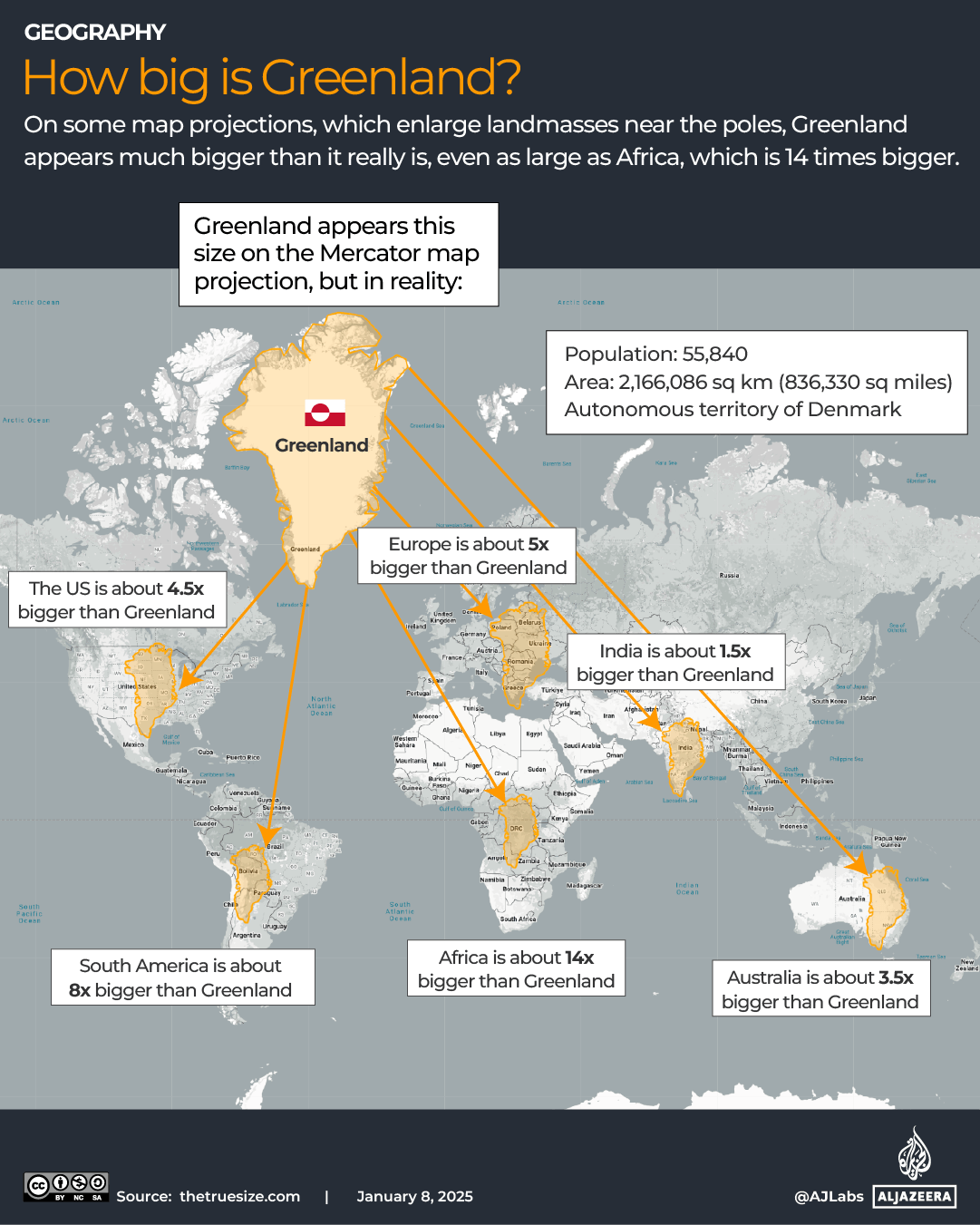
Some world maps today can be misleading in terms of how large Greenland actually looks. The Arctic island is 2.17 million square kilometres (836,330 square miles), making it about three times the size of the US state of Texas.
However, the Danish territory is perceived to be larger based on maps. This is because modern world maps commonly use a template called the Mercator projection, devised by European cartographer Geert de Kremer in 1569. The projection has been criticised for distorting the proportions of landmasses.
On the Mercator map, Greenland’s territory is shown to be almost as large as Africa. However, in reality, 14 Greenlands can fit inside Africa.
How has Europe reacted to Trump’s latest threats?
French President Emmanuel Macron, German Chancellor Merz, Italian Prime Minister Giorgia Meloni, Polish Prime Minister Donald Tusk, Spanish Prime Minister Pedro Sanchez, British Prime Minister Keir Starmer, and Danish Prime Minister Mette Frederiksen issued a joint statement on Monday.
They steered clear of any direct criticism of Trump, but made it clear that they were opposed to any US effort to take Greenland by force.
“Greenland belongs to its people. It is for Denmark and Greenland, and them only, to decide on matters concerning Denmark and Greenland,” they said.
Nissen from Think Tank Europa said that if Trump’s threat were to materialise, it could “represent a fundamental rupture” in the relationship between the US and EU as well as “the collapse of the current international order, including NATO and the liberal world order.”
“This underscores Europe’s vested interest in doing everything possible to downplay the likelihood of this ever becoming a reality,” she said, “preserving stability and ensuring that speculative threats remain just that – speculative.”
