Skip linksSkip to Content
play
Live
Navigation menu
  • News
    • Africa
    • Asia
    • US & Canada
    • Latin America
    • Europe
    • Asia Pacific
  • Middle East
  • Explained
  • Opinion
  • Sport
  • Video
    • Features
    • Economy
    • Human Rights
    • Climate Crisis
    • Investigations
    • Interactives
    • In Pictures
    • Science & Technology
    • Podcasts
    • Travel
play
Live

In Pictures

Gallery|Climate Crisis

Where Amazon meets ocean: A Brazilian community fights rising tides

Climate change reshapes Vila do Pesqueiro as families adapt to surging tides, erosion, and loss of ancestral homes.
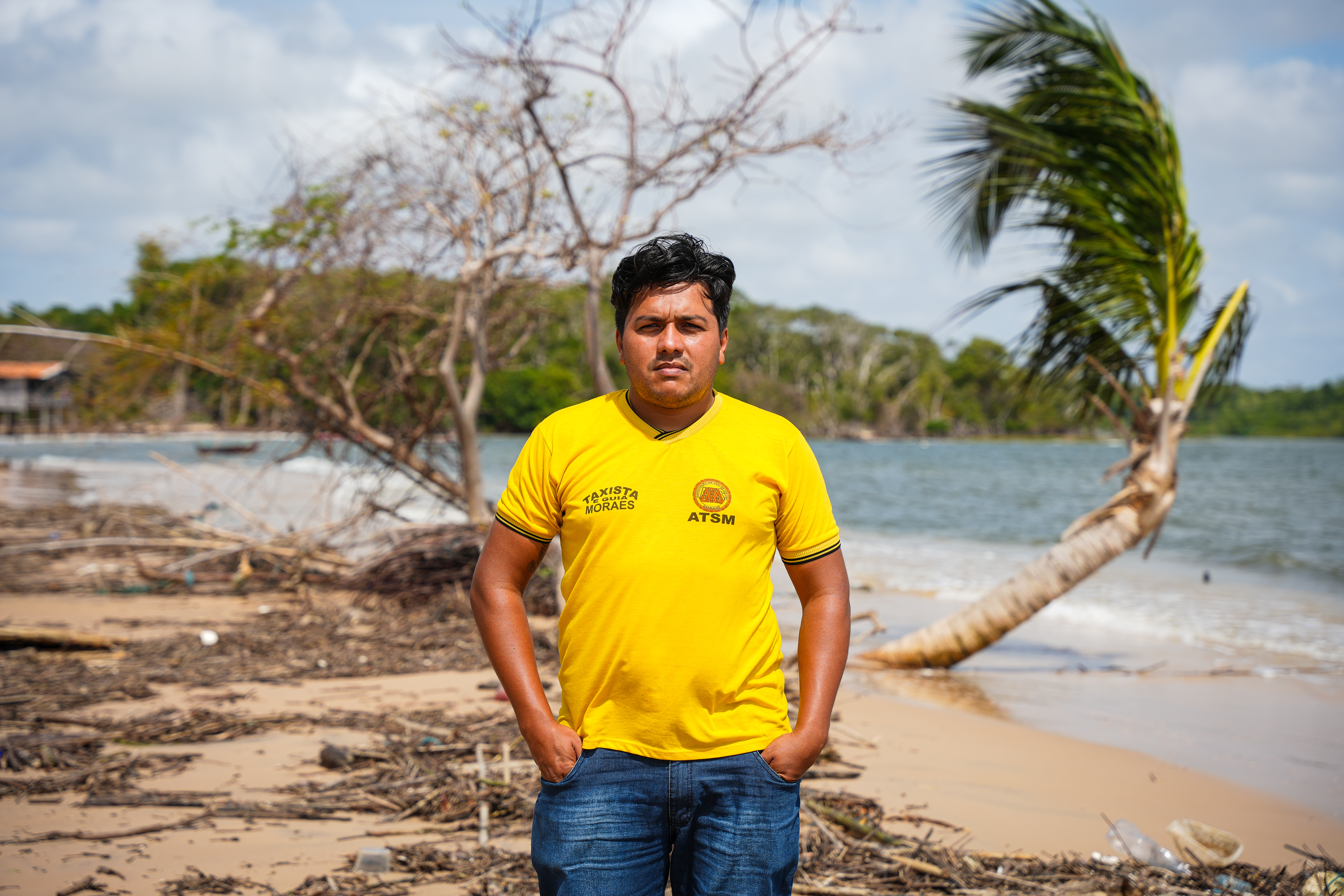
A man poses for a photo at a beach.
Life on Marajo island grows tougher with each rising tide, but the community remains rooted in the place they call home [Filipe Bispo/IOM]
By Juliana Hack
Published On 10 Nov 202510 Nov 2025

Share

facebooktwitterwhatsappcopylink

Save

On Marajo Island, at the confluence of the Amazon River and Atlantic Ocean in northern Brazil, life ebbs and flows with the tides.

For more than four decades, Ivanil Brito found paradise in her modest stilt house, just 20 metres (65ft) from the shoreline, where she and her husband Catito fished, cultivated crops, and tended to livestock.

“I was a very happy person in that little piece of land. That was my paradise,” she says.

That paradise vanished during a violent storm in February 2024, when relentless waters surged through Vila do Pesqueiro town, eroding the coastline that had nourished generations. “Even though we didn’t move far, it feels like a completely different world,” says Ivanil from their new settlement less than a kilometre (half a mile) inland. “This is a mangrove area – hotter, noisier, and not a place where we can raise animals or grow crops.”

Vila do Pesqueiro, home to about 160 families, lies within the Soure Marine Extractive Reserve, a protected area under the Chico Mendes Institute for Biodiversity Conservation. Established to preserve traditional ways of life and sustainable resource management, the reserve now confronts the harsh realities of climate change. While fishing remains the primary livelihood, local cuisine and tourism provide supplementary income to the residents. Yet, intensifying tides and accelerating erosion threaten their existence.

For Ivanil’s son Jhonny, a fisherman studying biology at Universidade do Para, in the Marajo-Soure campus, these transformations are worrying. “The place where our houses used to be is now underwater,” he says. “For me, moving isn’t just about safety – it’s about protecting the place and the people who shaped my life.”

Advertisement

Meanwhile, residents like Benedito Lima and his wife Maria Lima have chosen to remain, despite their home now standing perilously close to the water’s edge. Leaving would mean surrendering their livelihood. “Every new tide shakes the ground,” Benedito says, gazing towards what used to be a safely distant canal. “This isn’t even the high-tide season yet.”

Climate adaptation here takes various forms. Some rebuild farther inland, while others adjust their daily routines to accommodate the sea’s advance. Community leader Patricia Ribeiro believes a collective resilience sustains Vila do Pesqueiro. “Our stories have always been passed down through generations,” she says. “This is our home, our ancestry. We want to stay here to protect what our families built. As long as we’re together, we won’t give up.”

As Brazil prepares to host the 30th United Nations Climate Change Conference (COP30) in nearby Belem, communities like Vila do Pesqueiro exemplify what is at stake. Through its initiatives, the International Organization for Migration (IOM) says it supports efforts to enhance resilience, protect livelihoods, and ensure these families can continue living safely on their ancestral lands.

This photo gallery was provided by the International Organization for Migration.

Rising tides and coastal devastation have reshaped life in Marajó, washing away homes and livelihoods along the shore.
Rising tides and coastal devastation have reshaped life in Marajo, washing away homes and livelihoods along the shore. [Filipe Bispo/IOM]
Advertisement
Ivanil stands near the mangroves where her stilt home once stood, remembering the night the tide swallowed her land.
Ivanil stands near the mangroves where her stilt home once stood, remembering the night the tide swallowed her land. [Filipe Bispo/IOM]
“Even though we didn’t move far, it feels like a completely different world,” says Ivanil, now resettled less than a kilometer inland.
“Even though we didn’t move far, it feels like a completely different world,” says Ivanil, now resettled less than a kilometre (half a mile) inland. [Filipe Bispo/IOM]
Though Jhonny moved with his mother, Ivanil, to higher ground, his thoughts remain with the families still living by the canal.
Though Jhonny moved with his mother, Ivanil, to higher ground, his thoughts remain with the families still living by the canal. [Filipe Bispo/IOM]
“The place where our houses used to be is now underwater,” says Jhonny. “For me, moving isn’t just about safety – it’s about protecting the people who shaped my life.”
“The place where our houses used to be is now underwater,” says Jhonny. “For me, moving isn’t just about safety - it’s about protecting the people who shaped my life.” [Filipe Bispo/IOM]
Fishing remains the community’s lifeline – a trade passed down through generations, even as the tides claim more of the coast each year.
Fishing remains the community’s lifeline - a trade passed down through generations, even as the tides claim more of the coast each year. [Filipe Bispo/IOM]
Advertisement
Along Marajó’s coast, areas that were once part of the village are now covered by water, showing how much the shoreline has moved in recent years.
Along Marajo’s coast, areas that were once part of the village are now covered by water, showing how much the shoreline has moved in recent years. [Filipe Bispo/IOM]
What used to be a busy path to the beach is now a stretch of water that deepens with every season.
What used to be a busy path to the beach is now a stretch of water that deepens with every season. [Filipe Bispo/IOM]
Benedito and Maria have chosen to remain by the shore, relying on fishing as their sole source of livelihood.
Benedito and Maria have chosen to remain by the shore, relying on fishing as their sole source of livelihood. [Filipe Bispo/IOM]
“It was a very strong tide, with a lot of current,” remembers Benedito. “We used to have sand dunes and trees all along the shore – now there’s nothing left.”
“It was a very strong tide, with a lot of current,” remembers Benedito. “We used to have sand dunes and trees all along the shore - now there’s nothing left.” [Filipe Bispo/IOM]
Pieces of furniture, fishing nets, and fence posts lie tangled in the mangroves – traces of homes the sea took away.
Pieces of furniture, fishing nets, and fence posts lie tangled in the mangroves - traces of homes the sea took away. [Filipe Bispo/IOM]
From her beachside restaurant, Enir watches visitors search for joy along a coastline that has lost much of its beauty.
From her beachside restaurant, Enir watches visitors search for joy along a coastline that has lost much of its beauty. [Filipe Bispo/IOM]
Each storm reshapes the coast a little more, leaving fewer landmarks for those who once knew every curve of the shore.
Each storm reshapes the coast a little more, leaving fewer landmarks for those who once knew every curve of the shore. [Filipe Bispo/IOM]
Patrícia, a community leader in Marajó, believes unity is key to recovery and hopes tourism will help families rebuild.
Patricia, a community leader in Marajo, believes unity is key to recovery and hopes tourism will help families rebuild. [Filipe Bispo/IOM]


  • About

    • About Us
    • Code of Ethics
    • Terms and Conditions
    • EU/EEA Regulatory Notice
    • Privacy Policy
    • Cookie Policy
    • Cookie Preferences
    • Accessibility Statement
    • Sitemap
    • Work for us
  • Connect

    • Contact Us
    • User Accounts Help
    • Advertise with us
    • Stay Connected
    • Newsletters
    • Channel Finder
    • TV Schedule
    • Podcasts
    • Submit a Tip
    • Paid Partner Content
  • Our Channels

    • Al Jazeera Arabic
    • Al Jazeera English
    • Al Jazeera Investigative Unit
    • Al Jazeera Mubasher
    • Al Jazeera Documentary
    • Al Jazeera Balkans
    • AJ+
  • Our Network

    • Al Jazeera Centre for Studies
    • Al Jazeera Media Institute
    • Learn Arabic
    • Al Jazeera Centre for Public Liberties & Human Rights
    • Al Jazeera Forum
    • Al Jazeera Hotel Partners

Follow Al Jazeera English:

  • facebook
  • twitter
  • youtube
  • instagram-colored-outline
  • rss
Al Jazeera Media Network logo
© 2026 Al Jazeera Media Network

You might also like:

live israeli attacks kill 76 no aid relief yet for... | thailand readies homecoming for stolen ancient sta... | russia ukraine war list of key events day 1185... | german woman arrested after mass stabbing at hambu... | vietnam orders ban on popular messaging app... | need answers will sri lankas tamils find war closu... | live israeli attacks kill 85 in gaza as starvation... | florida court orders ex mexican security chief to ...