Skip linksSkip to Content
play
Live
Navigation menu
  • News
    • Africa
    • Asia
    • US & Canada
    • Latin America
    • Europe
    • Asia Pacific
  • Middle East
  • Explained
  • Opinion
  • Sport
  • Video
    • Features
    • Economy
    • Human Rights
    • Climate Crisis
    • Investigations
    • Interactives
    • In Pictures
    • Science & Technology
    • Podcasts
    • Travel
play
Live
Navigation menu
  • Syria's War
  • Live: A year since fall of al-Assad
  • Hope and celebration in Syria
  • How many Syrians have returned?
  • Watch: The Road to Damascus
  • The fight for justice in Syria
  • Watch: One year after al-Assad

In Pictures

Gallery|Syria's War

Aleppo’s soap makers, now making their soaps in a free Syria

The al-Jubailis have owned and operated their soap factory for generations, and they plan to keep doing so.
Generations of soap makers keep Aleppo tradition alive
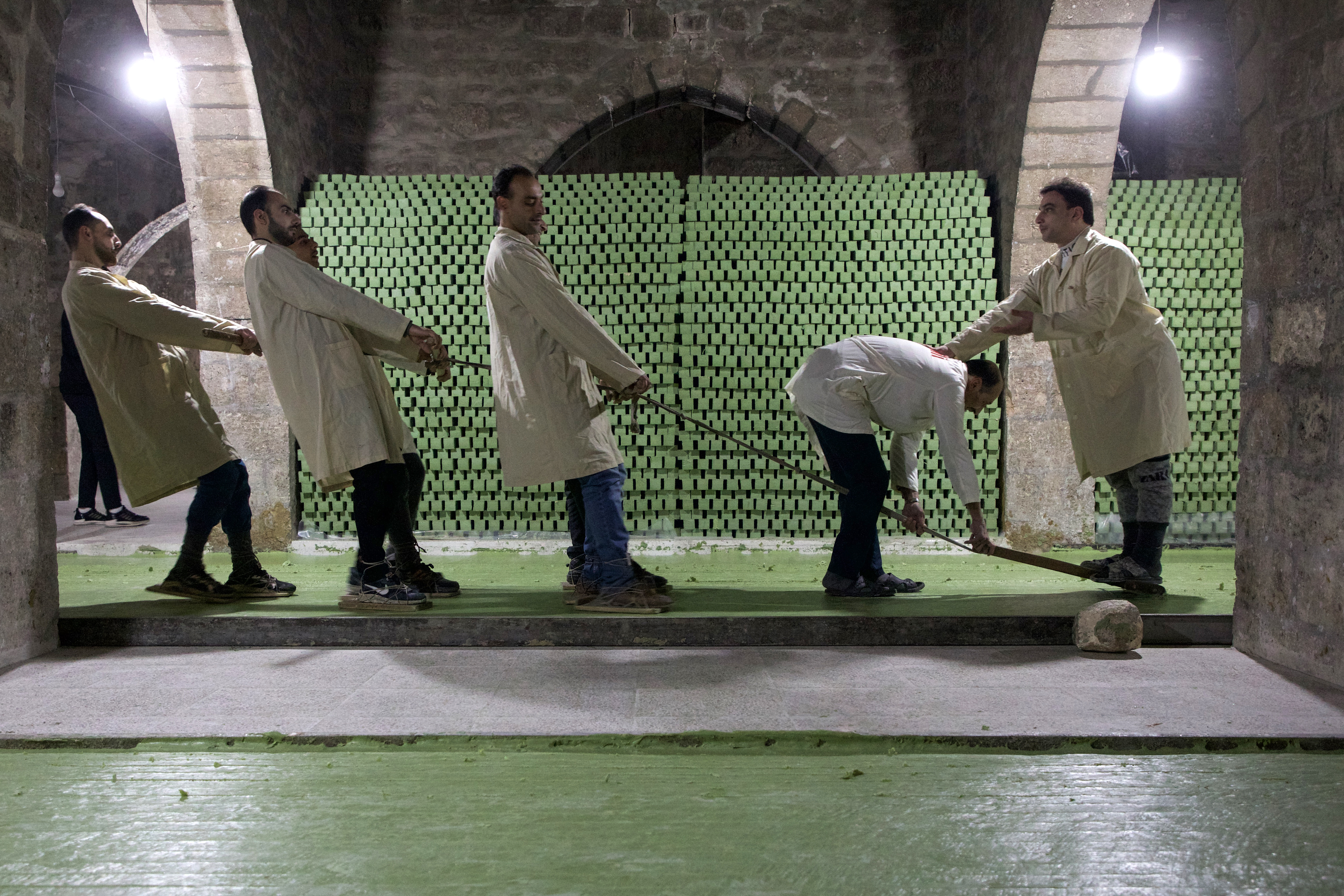
Cutting the cooled soap requires one person standing on the blade-laden plate while four of five others pull him and the blades through the solid soap [Ali Haj Suleiman/Al Jazeera]
By Ali Haj Suleiman
Published On 26 Dec 202426 Dec 2024

Share

facebooktwitterwhatsappcopylink

Save

Aleppo, Syria – Legend says that more than 2,000 years ago, women in Aleppo discovered that combining wild Anabasis plants with olive oil makes a foam effective for cleaning.

This discovery marked the beginning of Aleppo’s renowned soap-making tradition, a craft that has been passed down through generations.

Despite having survived countless challenges over the centuries, the recent war presented an unprecedented threat to Aleppo’s soap industry.

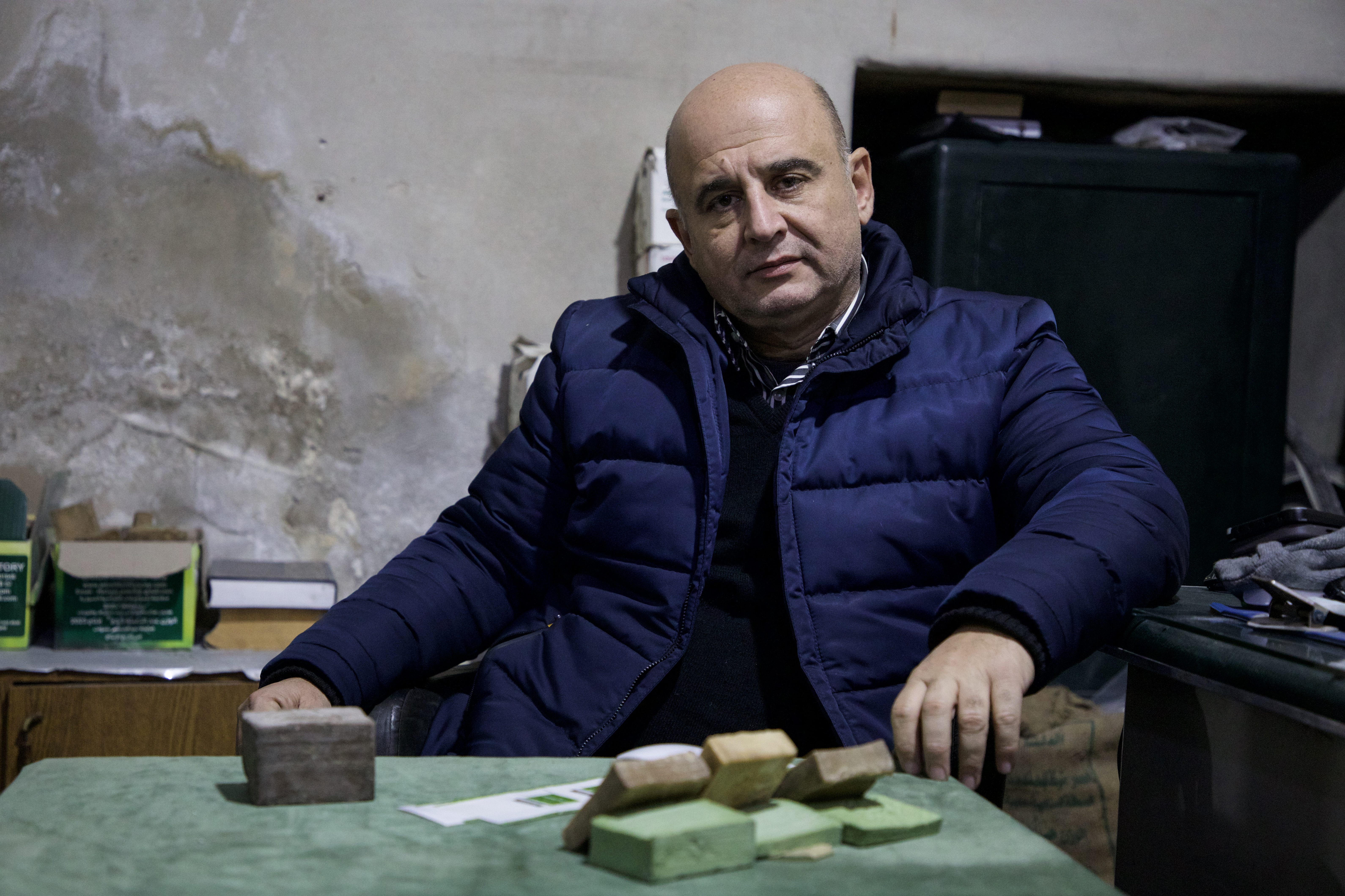
“In the last 15 years, I’ve had to restore my soap factory twice,” said Hisham al-Jubaili, whose family has run the soap factory for 700 years.

“The profession nearly vanished due to the war, earthquakes and displacement. But our passion kept us going.”

Revitalising Aleppo’s historic markets

Aleppo’s once-vibrant old markets are beginning to come back to life, although scars of war remain – especially from the intense bombing campaigns by Syrian and Russian forces in 2016.

Entering the covered market, visitors are immediately greeted by the familiar scent of soap mixed with spices and incense and by rows of shops filled with traditional goods, handcrafted souvenirs, and, recently, items adorned with the colours of the new Syrian flag.

Bisher Nasimi, a 25-year-old soap merchant, noted a marked improvement in market activity. “Business has increased by 80 percent, and I believe it will continue to improve in the coming months,” he said as he assisted a customer looking for perfume and incense.

Making Aleppo’s famous soap

The soap is made by blending alkaline substances with olive and laurel oils in varying proportions. It is cooked, then cooled in thick slabs on the floor basins until it is solid enough to cut.

Advertisement

The more laurel oil used, the higher the quality and price of the soap. Prices range from $1.50 per kilogramme for soap without laurel oil to $3 for soap containing 5 percent laurel oil, with prices doubling for each additional 5 percent of laurel oil, up to 40 percent.

But the war severely impacted the industry, with only 15 factories remaining out of about 120 before the war.

Making Aleppo soap is a lengthy process. After the mixture is prepared, it is left to cure for six to eight months, allowing it to oxidise and change colour from dark green to yellow.

Al-Jubaili explains that Aleppans traditionally buy soap and store it for years before using it.

“The longer the soap dries, the better,” he said. “The older it gets, the less free alkali it contains, turning it into a soothing ointment for the skin.”

Al-Jubaili treasures five pieces of soap that are 75 years old. He has used only one and plans to preserve the rest for a future museum dedicated to laurel soap production in his factory that will honour the resilience of a craft that has survived despite the many challenges of war.

Generations of soap makers keep Aleppo tradition alive
Soap-making in Aleppo is more than just a business - it is a generational craft passed down through many local families. [Ali Haj Suleiman/Al Jazeera]
Advertisement
Generations of soap makers keep Aleppo tradition alive
Workers pump the soap mixture into cooling basins. [Ali Haj Suleiman/Al Jazeera]
Generations of soap makers keep Aleppo tradition alive
As the soap cools, it solidifies into large slabs. [Ali Haj Suleiman/Al Jazeera]
Generations of soap makers keep Aleppo tradition alive
Stacking the freshly cut soap, which is still a bright green colour. As it cures, it turns more yellow with time. [Ali Haj Suleiman/Al Jazeera]
Generations of soap makers keep Aleppo tradition alive
Workers tie wooden boards to their feet to avoid denting the soap slabs. [Ali Haj Suleiman/Al Jazeera]
Generations of soap makers keep Aleppo tradition alive
Each bar of soap is stamped with a brass stamp that bears the name of the factory and the soap's classification. Shown here is an array of stamps the Jubaili factory uses, with bottles of oils and stacks of soap in the background. [Ali Haj Suleiman/Al Jazeera]
Advertisement
Generations of soap makers keep Aleppo tradition alive
Hisham al-Jubaili says every worker’s father - and grandfather - was involved in the same soap-making craft. [Ali Haj Suleiman/Al Jazeera]
Generations of soap makers keep Aleppo tradition alive
"We teach our children the importance of soap-making from an early age, ensuring the craft continues," al-Jubaili said. A bar of soap has to cure for nine months before it is ready to use. [Ali Haj Suleiman/Al Jazeera]
Generations of soap makers keep Aleppo tradition alive
"The tradition is passed down from one generation to the next ... I have a picture of my children playing with soap, and my father kept a picture of me as a child playing with soap, too," al-Jubaili continued. [Ali Haj Suleiman/Al Jazeera]


  • About

    • About Us
    • Code of Ethics
    • Terms and Conditions
    • EU/EEA Regulatory Notice
    • Privacy Policy
    • Cookie Policy
    • Cookie Preferences
    • Accessibility Statement
    • Sitemap
    • Work for us
  • Connect

    • Contact Us
    • User Accounts Help
    • Advertise with us
    • Stay Connected
    • Newsletters
    • Channel Finder
    • TV Schedule
    • Podcasts
    • Submit a Tip
    • Paid Partner Content
  • Our Channels

    • Al Jazeera Arabic
    • Al Jazeera English
    • Al Jazeera Investigative Unit
    • Al Jazeera Mubasher
    • Al Jazeera Documentary
    • Al Jazeera Balkans
    • AJ+
  • Our Network

    • Al Jazeera Centre for Studies
    • Al Jazeera Media Institute
    • Learn Arabic
    • Al Jazeera Centre for Public Liberties & Human Rights
    • Al Jazeera Forum
    • Al Jazeera Hotel Partners

Follow Al Jazeera English:

  • facebook
  • twitter
  • youtube
  • instagram-colored-outline
  • rss
Al Jazeera Media Network logo
© 2026 Al Jazeera Media Network

You might also like:

live israeli attacks kill 76 no aid relief yet for... | thailand readies homecoming for stolen ancient sta... | russia ukraine war list of key events day 1185... | german woman arrested after mass stabbing at hambu... | vietnam orders ban on popular messaging app... | need answers will sri lankas tamils find war closu... | live israeli attacks kill 85 in gaza as starvation... | florida court orders ex mexican security chief to ...