Skip linksSkip to Content
play
Live
Navigation menu
  • News
    • Africa
    • Asia
    • US & Canada
    • Latin America
    • Europe
    • Asia Pacific
  • Middle East
  • Explained
  • Opinion
  • Sport
  • Video
    • Features
    • Economy
    • Human Rights
    • Climate Crisis
    • Investigations
    • Interactives
    • In Pictures
    • Science & Technology
    • Podcasts
    • Travel
play
Live

In Pictures

Gallery|Protests

In Pictures: Indian farmers protest ‘black’ farm laws

Tens of thousands of farmers have blocked highways leading to the capital New Delhi for three weeks.
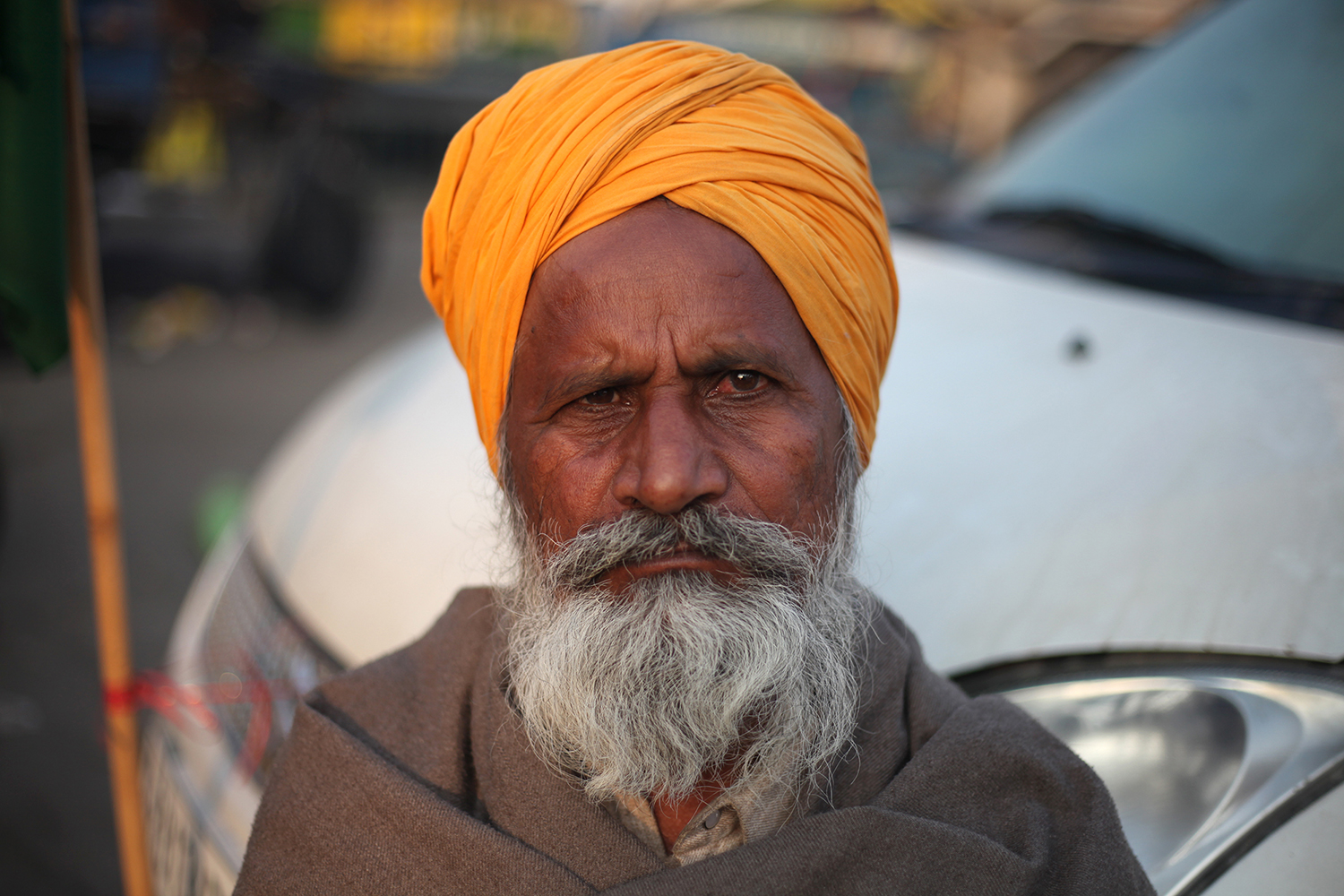
"We came along with all of our family members to be a part of this protest," 70-year-old farmer Rathyard Singh from Haryana state said. [Vikar Syed/Al Jazeera]
By Vikar Syed
Published On 14 Dec 202014 Dec 2020

Share

facebooktwitterwhatsappcopylink

Save

Protesting Indian farmers are holding a one-day hunger strike on Monday to demand the scrapping of three new farm laws, which they say will drive down crop prices and were passed without their consultation.

Tens of thousands of farmers have blocked highways leading to the capital, New Delhi, for three weeks as police continue to ban them from entering the city.

The protests, which have spread to other parts of India, have been supported by workers’ groups, opposition parties and other civil society groups.

Several rounds of talks with the Indian government, which is led by the Hindu nationalist Bharatiya Janata Party (BJP), have failed to produce any breakthroughs.

The government says the new laws will allow farmers to sell their produce directly to private players outside the Agriculture Produce Market Committee (APMC) markets controlled by the state governments.

The laws also aim to bring in contract farming, which would allow a farmer and a prospective buyer to strike a deal before the actual planting.

But farmers say the new laws will pave way for the private sector to bypass the traditional “mandi” system that guaranteed them a minimum price for their produce.

“We will face a huge loss from these new laws. We can’t earn good profit on our crops if we sell below the minimum support price,” Ranjeet Singh, a 70-year-old farmer said, nursing his tea on a cold morning at the Singhu border outside New Delhi.

The farmers, male and female, brought their supplies with them, cooking together at the protest sites. Despite the temperature dipping considerably at night, they sleep under the tractors and trucks they drove there.

Advertisement

“We will not let government offices work when you pass these black laws which are unacceptable to us. I left early in the morning, crossed many barricades and walked by foot to join the protest at Tikri border,” said Sharmila Soda, a 45-year farmer from Haryana.

Farmers say they are prepared to spend months on the highway if the laws are not repealed. NGOs are working to provide them with food and shelter as doctors remain on standby with a medical camp.

“I belong to a farmer’s family, so I joined too,” 23-year-old college student Hassan from Punjab state, which has seen the maximum mobilisation during the ongoing protest.

From dawn to dusk, slogans and songs blare from loudspeakers as TV cameras and media reporters follow the agitating farmers.

“The government is using a sold-out media to portray us as terrorists. It is trying to take down our social movement,” says Harinder Happy, 23, a doctoral student and member of a students’ group.

“Our students are going to many villages across Punjab to educate farmers about this new farm bill and its negative effects,” said Sukhripir Kaur, 22, of the Punjab Students Union.

“Our parents work in the fields and they are the backbone of our economy. What will they do if our land will be controlled by the government and corporate sectors?” she asked.

To press for their demands, the farmers' union have called for a hunger strike on Monday across the country. Outside India, protests to support the farmers have been held in Canada, England and Scotland. [Vikar Syed/Al Jazeera]
Advertisement
To prevent farmers from marching to New Delhi, security forces blocked the national highway on the Haryana-Delhi border. [Vikar Syed/Al Jazeera]
Aerial view of the Singhu border, where thousands of vehicles have been stopped by Delhi police to prevent them from entering New Delhi. [Vikar Syed/Al Jazeera]
College students from Haryana and Punjab states paint slogans on the walls, using quotes from India's freedom fighters. "Being educated is to spread what we have learned, this is the way of our protest," Sahil Badgujarl, a 25-year-old student from Batra said. [Vikar Syed/Al Jazeera]
"Publication houses are giving us these books with huge discounts. Some books are funded by student unions that came from across the country," said Manisha, a 25-year-old student. [Vikar Syed/Al Jazeera]
A group of students working with Khalsa Aid charity came up with the initiative to organise book stalls at Singhu and Tikri borders. [Vikar Syed/Al Jazeera]
Advertisement
“I have done hotel management and have good knowledge about Ayurvedic medicines. I suggested to my parents that we should take part in this protest by opening an Ayurvedic stall in this protest, where we offer tea and medicines”. 21-year-old Manveen Kaur from Bahadurgad, Haryana narrated while putting tea in disposable cups on 8 Dec. [Vikar Syed/Al Jazeera]
"I have done hotel management and have good knowledge about Ayurvedic medicines. I suggested to my parents that we should take part in this protest by opening an Ayurvedic stall," said 21-year-old Manveen Kaur from Bahadurgadh, Haryana. [Vikar Syed/Al Jazeera]
"We want to mark this protest not only on social media but on the streets of India," Premjeet Singh, 22, said. [Vikar Syed/Al Jazeera]
Women from villages in Patiala, Punjab, joined in by feeding themselves and the other protesters. "We do this work shift-wise. After two days, we go back to our village and will be replaced by other women," said Parminder Jeet Kour. [Vikar Syed/Al Jazeera]
Maan Singh, 50, a Sikh volunteer, heads the community kitchen for nearly 30,000 farmers at Singhu border. "It’s open for 24 hours and we provide food to everyone," he says. [Vikar Syed/Al Jazeera]


  • About

    • About Us
    • Code of Ethics
    • Terms and Conditions
    • EU/EEA Regulatory Notice
    • Privacy Policy
    • Cookie Policy
    • Cookie Preferences
    • Accessibility Statement
    • Sitemap
    • Work for us
  • Connect

    • Contact Us
    • User Accounts Help
    • Advertise with us
    • Stay Connected
    • Newsletters
    • Channel Finder
    • TV Schedule
    • Podcasts
    • Submit a Tip
    • Paid Partner Content
  • Our Channels

    • Al Jazeera Arabic
    • Al Jazeera English
    • Al Jazeera Investigative Unit
    • Al Jazeera Mubasher
    • Al Jazeera Documentary
    • Al Jazeera Balkans
    • AJ+
  • Our Network

    • Al Jazeera Centre for Studies
    • Al Jazeera Media Institute
    • Learn Arabic
    • Al Jazeera Centre for Public Liberties & Human Rights
    • Al Jazeera Forum
    • Al Jazeera Hotel Partners

Follow Al Jazeera English:

  • facebook
  • twitter
  • youtube
  • instagram-colored-outline
  • rss
Al Jazeera Media Network logo
© 2026 Al Jazeera Media Network

You might also like:

live israeli attacks kill 76 no aid relief yet for... | thailand readies homecoming for stolen ancient sta... | russia ukraine war list of key events day 1185... | german woman arrested after mass stabbing at hambu... | vietnam orders ban on popular messaging app... | need answers will sri lankas tamils find war closu... | live israeli attacks kill 85 in gaza as starvation... | florida court orders ex mexican security chief to ...