Skip linksSkip to Content
play
Live
Navigation menu
  • News
    • Africa
    • Asia
    • US & Canada
    • Latin America
    • Europe
    • Asia Pacific
  • Middle East
  • Explained
  • Opinion
  • Sport
  • Video
    • Features
    • Economy
    • Human Rights
    • Climate Crisis
    • Investigations
    • Interactives
    • In Pictures
    • Science & Technology
    • Podcasts
    • Travel
play
Live

In Pictures

Gallery|Environment

In Pictures: Lebanon’s dying fishing industry

Plagued by pollution, over-fishing and rapid development along the coast, Lebanon’s fishermen struggle to make a living.
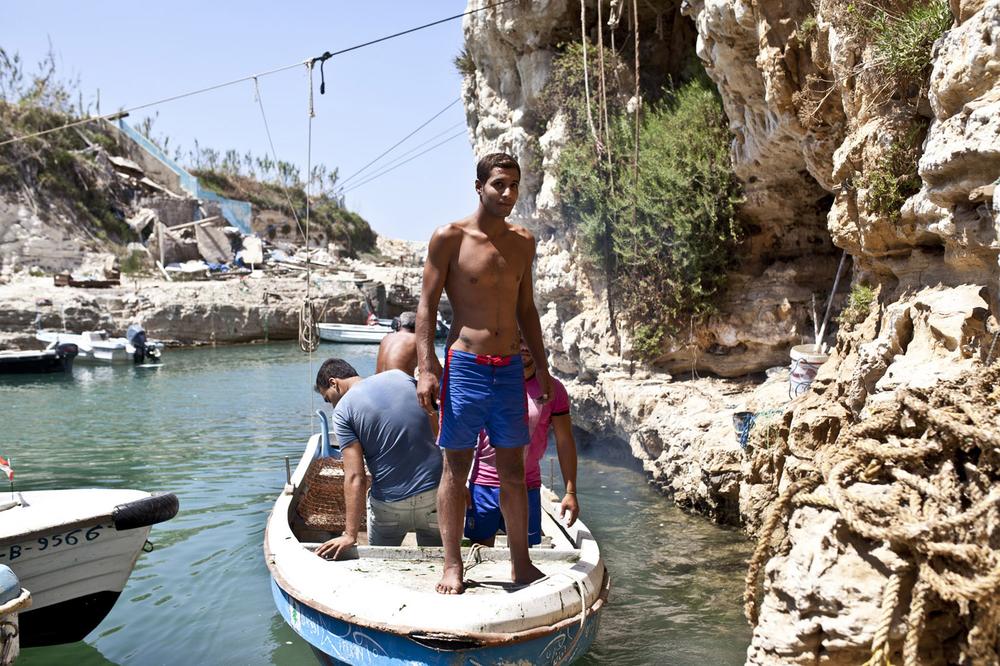
Mahmoud Krombi, 25 is one of the younger fishermen working at the Daliyeh fishing port. (***)Even the seaweed [which is vital to trap fishing] is dying from pollution,(***) he said.
News image
By David Shaw
Published On 20 Sep 201420 Sep 2014

Share

facebooktwitterwhatsappcopylink

Save

Beirut, Lebanon – For thousands of years,Lebanon’s coastline has been a vital source of sustenance for local residents. But privatisation and pollution have now made it increasingly difficult to scrape by on catches from the Mediterranean Sea.

But fishermen still head out into the local waters, attempting to make a living despite depleted fish sources and pressure to move away. “Fishing is all I know,” said Hamzi Khalil, 63, a fisherman from Beirut. “We fish, we eat. We don’t fish, we don’t eat.”

Daliyeh, one of the last public spaces in Beirut, contains Daliyeh Marina, a small but working fishing port which provides a base for an estimated 60-70 fishermen. The marina is under serious threat of permanent destruction due to a hotel project being planned for the area.

But the loss of the marina is not the only pressing issue affecting Lebanon’s fishing industry, which employs approximately 10,000 fishermen during peak seasons.

Most of Lebanon’s solid waste is deposited in landfills bordering the coast, and pollution is slowly leaking into the ocean, according to Lebanese group Greenline. Sewers also deposit straight into the Mediterranean; usually untreated, this wastewater sometimes contains industrial waste from factories. Greenline reported that much of the industrial waste dumped into the sea is not treated past the first-degree treatment level; international law requires that waste be treated to the fourth degree before disposal.

The use of illegal nets, which trap all size of fish, and a lack of regulations on fishing levels, have also had a devastating effect on the fish population, according to local fishermen. 

Advertisement

Khaled Sleit is the manager of Jal al-Baher, a fishing marina in Beirut. Al-Baher told Al Jazeera that fishermen at Daliyeh marina do not throw back smaller fish, thus hurting the fish populations. “Overfishing is the main reason in my opinion [for the shortage of fish],” he said. “They are keeping the small and the big, they don’t throw the small ones back.”

A resident of the neighbouring city of Sidon, Wissam Kall, 39, also works out of the Daliyeh marina. (***)This year has been [particularly] bad, no fish,(***) he said.
Advertisement
The Daliyeh fishing marina dates back approximately 75 years. It is now surrounded by new development projects.
Hamzi Khalil, 63, has been fishing at this port for 50 years. He said that if he is forced to leave the area, he will fight. (***)If you put me in a fine hotel and beach, I wouldn(***)t enjoy it as much as I enjoy it here.(***)
Sewage and other pollutants are dumped into the Mediterranean Sea, causing a devastating effect on the local environment and impact fishing levels.
Overfishing is also a serious problem. (***)They understand the impact but [the fishermen] are ignorant, very selfish, [and] very greedy,(***) Khaled Sleit, manager of Jal al-Baher fishing marina, said.
Some fishermen have had to sell their boats and look for other work due to the difficult economic situation. This man now fishes using only a float.
Advertisement
Some Syrian fishermen - who now live in Lebanon due to the Syrian war - have also joined the industry. Lebanese fishermen complain that Syrian refugees work for lower wages and sell fish at cheaper prices.
Trap fishing is not the only method used in Lebanon; lines, nets, and sometimes even spear guns are used to catch fish.
Fishermen at Jal al-Baher argue over the day(***)s catch. Lebanese fishermen can sometimes earn as little as $30 per day, not counting expenses.
Few fishermen are allowing their children to join the same line of work. (***)You get attached to the sea,(***) said fisherman Najb Deek. (***)[But] this is life [and] there is nothing we can do about it.(***)


  • About

    • About Us
    • Code of Ethics
    • Terms and Conditions
    • EU/EEA Regulatory Notice
    • Privacy Policy
    • Cookie Policy
    • Cookie Preferences
    • Accessibility Statement
    • Sitemap
    • Work for us
  • Connect

    • Contact Us
    • User Accounts Help
    • Advertise with us
    • Stay Connected
    • Newsletters
    • Channel Finder
    • TV Schedule
    • Podcasts
    • Submit a Tip
    • Paid Partner Content
  • Our Channels

    • Al Jazeera Arabic
    • Al Jazeera English
    • Al Jazeera Investigative Unit
    • Al Jazeera Mubasher
    • Al Jazeera Documentary
    • Al Jazeera Balkans
    • AJ+
  • Our Network

    • Al Jazeera Centre for Studies
    • Al Jazeera Media Institute
    • Learn Arabic
    • Al Jazeera Centre for Public Liberties & Human Rights
    • Al Jazeera Forum
    • Al Jazeera Hotel Partners

Follow Al Jazeera English:

  • facebook
  • twitter
  • youtube
  • instagram-colored-outline
  • rss
Al Jazeera Media Network logo
© 2026 Al Jazeera Media Network

You might also like:

live israeli attacks kill 76 no aid relief yet for... | thailand readies homecoming for stolen ancient sta... | russia ukraine war list of key events day 1185... | german woman arrested after mass stabbing at hambu... | vietnam orders ban on popular messaging app... | need answers will sri lankas tamils find war closu... | live israeli attacks kill 85 in gaza as starvation... | florida court orders ex mexican security chief to ...