Skip linksSkip to Content
play
Live
Navigation menu
  • News
    • Africa
    • Asia
    • US & Canada
    • Latin America
    • Europe
    • Asia Pacific
  • Middle East
  • Explained
  • Opinion
  • Sport
  • Video
    • Features
    • Economy
    • Human Rights
    • Climate Crisis
    • Investigations
    • Interactives
    • In Pictures
    • Science & Technology
    • Podcasts
    • Travel
play
Live

In Pictures

Gallery

CAR refugees’ ‘Most Important Things’

Central African refugees have been crossing into DR Congo carrying only their most-treasured items.
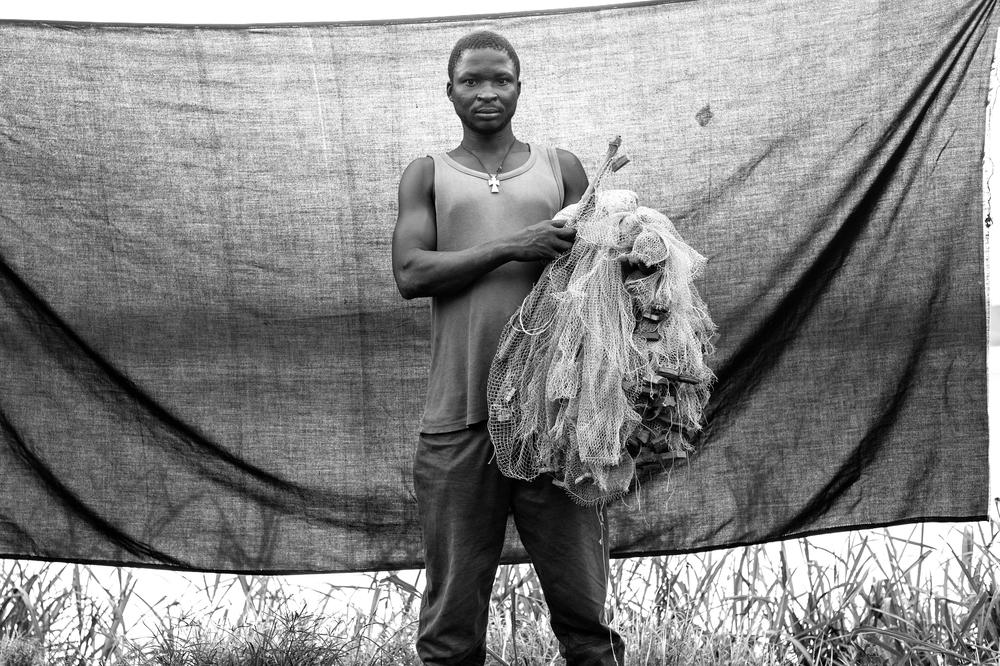
Jean Gerembo recalls Wednesday March 27, 2013, vividly. His wife and two children were staying with his mother-in-law, when Seleka forces entered his village of Batalimo. The Seleka heard from a neighbour that Jean(***)s mother had saved some money, and at 11:45 that night there came a knock at the door. Jean hid beneath his mother(***)s bed and told her to remain silent, and not to answer it. A few moments later, the door was kicked in. One of the soldiers walked over to the bed and slit the old woman(***)s throat. Terrified, Jean stayed under the bed as they looted the home. The next morning, he found eight young people who were, as he said, "brave enough to to help me to bury my mother." After the burial, Jean found his family, gathered a few essentials, and together they fled across the Oubangi River in his small fishing boat. The most important thing that Jean was able to bring with him from CAR was his fishing net. He says that the net allows him to live, and to earn. "Some of the fish I sell, some we eat. I use the money to buy clothes and to pay the local people for plantains, cassava and peanuts," he said. "Many people have suffered. Mine is just one story."
News image
By Brian Sokol
Published On 28 Feb 201428 Feb 2014

Share

facebooktwitterwhatsappcopylink

Save

Libenge, DR Congo – More than 60,000 residents of the Central African Republic have fled to the Democratic Republic of Congo since April 2013, when Seleka rebels ousted the government in CAR’s capital, Bangui.

The mass displacement has been happening as rival militia – largely divided between Christian and Muslim groups – attack villages believed to be affiliated with the other. Whole villages have been razed to the ground, as men armed mostly with machetes, but also with firearms, spread a deadly cycle of brutal violence in ongoing tit-for-tat revenge massacres.

Some 30,000 of those displaced live in four refugee camps set up by the UN High Commission for Refugees in DRC. For the majority, there was no time to pack before escaping. They fled extreme violence and chaos and arrived exhausted and traumatised in the DRC. They could take only the most essential and lightest belongings. Those belongings are featured in this photo essay by Brian Sokol, and include a sandal that helped an old woman, a pair of crutches used by a man to reach safety and a boy’s photo of his slain father. Another boy named the family members who escaped to safety with him as his most important possession – and many others would feel the same. 

The photos here were taken at Batanga Transit Centre, Boyabo Refugee Camp and Libenge village in August 2013. Many of those in these photographs have since been moved to safer locations, far from the river which divides CAR from DRC.

Veronique Gonoko is around 85, and has lived almost her entire life in the riverside village of Zinga in CAR. In this portrait, she holds aloft the one remaining sandal that accompanied her from CAR. A fellow refugee gave her a mismatched one to replace it. She says that it is difficult to look across the river and see the village where she lived her entire life, but can no longer safely return. She fled her home when armed men "arrived in cars and trucks, shooting and killing along the road".
Advertisement
Jean-Baptiste Maka is originally from the village of Moungoumba, but was working as a nurse in CAR(***)s capital of Bangui at the time it fell to Seleka forces. After fleeing to DR Congo, he found refuge with a family in Libenge. In a twist of fate, many of the Congolese families currently sheltering Central African refugees once lived with the same individuals when their roles were reversed. The most important thing that Jean-Baptiste was able to bring with him is his CAR national ID card: "It proves that I(***)m here seeking refuge - and gives me the right to register with the UN so that I will be protected."
Fideline Poga Za holds one of her school notebooks, after fleeing with her family to DRC, having seen a businessman executed in front of them. "I couldn(***)t take my school bag, my shoes, or the coloured ribbons for my hair," said the 13-year-old. "But I did bring my notebooks and my pen... We have suffered so much. I want to study so that I can become someone."
Emmaus Faybuna holds a photo of his father, who was murdered on his doorstep. After the killing, Emmaus packed a few belongings into a bag and fled into the night. He wandered for around a month before making it to DRC. "This photo is important to me because I love my father. I love him very much," said the 17-year-old. "And before, in life, he loved me too."
Benjamin Kombo fled his village of Mongo, with his wife and four children, crossing the perilous Oubangi River which separates CAR from DRC in a canoe. He now supports himself by mending clothes for fellow refugees and locals in Batanga with his sewing machine. "It is my life, it is my blood," he said. "I use it to be able to buy food for my family."
Marcelin Longue(***)s crutches were made for him by his woodworking elder brother, who was killed by Seleka fighters. The armed men also took Marcelin(***)s wheelchair, before he fled with his pregnant wife and two young children. The third child was born six days after reaching DRC. Marcelin(***)s crutches "are like my legs. They allow me to walk. If I didn(***)t have them, I could have died."
Advertisement
Bonheur Mandjakete (second from right) watched his friend, Princi, murdered by Seleka fighters in Moungoumba. The nine-year-old said that his relatives had lost all their possessions, but, he added, "the most important thing is that I have my life and my family".
Lucie Kaledoka cannot straighten one of her legs. Her husband and her son carried the 38-year-old to safety after Seleka fighters attacked. Her most important possession, she says, is her bible, which "guides me in my life".
Antoine Wamale guesses himself to be somewhere around 80 years old. "I heard that people were being murdered. I heard that the Seleka don(***)t like old men, and that they kill them when they find them," said the widower. "It is not for nothing that I chose to bring the cup," he said. "For me, I would have been ashamed to ask every day, just to take a drink of water. Having my own cup gave me some degree of independence. People become tired of being asked for things all the time, and eventually they say (***)no(***)."


  • About

    • About Us
    • Code of Ethics
    • Terms and Conditions
    • EU/EEA Regulatory Notice
    • Privacy Policy
    • Cookie Policy
    • Cookie Preferences
    • Accessibility Statement
    • Sitemap
    • Work for us
  • Connect

    • Contact Us
    • User Accounts Help
    • Advertise with us
    • Stay Connected
    • Newsletters
    • Channel Finder
    • TV Schedule
    • Podcasts
    • Submit a Tip
    • Paid Partner Content
  • Our Channels

    • Al Jazeera Arabic
    • Al Jazeera English
    • Al Jazeera Investigative Unit
    • Al Jazeera Mubasher
    • Al Jazeera Documentary
    • Al Jazeera Balkans
    • AJ+
  • Our Network

    • Al Jazeera Centre for Studies
    • Al Jazeera Media Institute
    • Learn Arabic
    • Al Jazeera Centre for Public Liberties & Human Rights
    • Al Jazeera Forum
    • Al Jazeera Hotel Partners

Follow Al Jazeera English:

  • facebook
  • twitter
  • youtube
  • instagram-colored-outline
  • rss
Al Jazeera Media Network logo
© 2026 Al Jazeera Media Network

You might also like:

live israeli attacks kill 76 no aid relief yet for... | thailand readies homecoming for stolen ancient sta... | russia ukraine war list of key events day 1185... | german woman arrested after mass stabbing at hambu... | vietnam orders ban on popular messaging app... | need answers will sri lankas tamils find war closu... | live israeli attacks kill 85 in gaza as starvation... | florida court orders ex mexican security chief to ...