Skip linksSkip to Content
play
Live
Navigation menu
  • News
    • Africa
    • Asia
    • US & Canada
    • Latin America
    • Europe
    • Asia Pacific
  • Middle East
  • Explained
  • Opinion
  • Sport
  • Video
    • Features
    • Economy
    • Human Rights
    • Climate Crisis
    • Investigations
    • Interactives
    • In Pictures
    • Science & Technology
    • Podcasts
    • Travel
play
Live

In Pictures

Gallery

Cairo crisis continues

Rival demonstrations in Egypt’s capital lead to the military issuing an ultimatum.
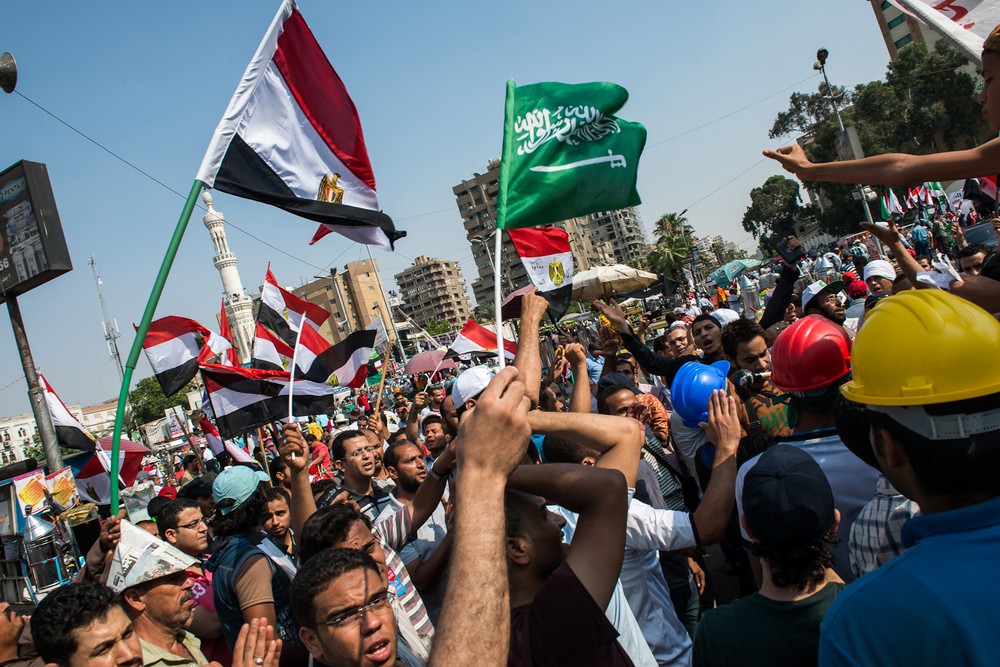
Pro-Morsi and Muslim Brotherhood supporters filled Rab(***)a Aldawiya Square in Nasr City, Cairo
News image
By Jonathan Kalan
Published On 1 Jul 20131 Jul 2013

Share

facebooktwitterwhatsappcopylink

Save

Cairo, Egypt – Widespread demonstrations calling for the resignation of President Mohamed Morsi continued into a second day on Monday, following the one-year anniversary of his inauguration on June 30. While nowhere near the turnout of the previous day’s record-breaking millions of protesters, numbers continued to grow throughout the day in Tahrir Square and elsewhere after anti-Morsi protesters issued an ultimatum – calling for Morsi to resign by 5pm on Tuesday, or else face increased civil disobedience.

Supporters of President Morsi and the Muslim Brotherhood also staged demonstrations around the city, although far from the main anti-Morsi protests for fear of clashes. Late on Sunday night, anti-Morsi protesters had stormed the Muslim Brotherhood Headquarters in Mokattam with petrol bombs, breaking in and setting the building ablaze. The resulting clashes reportedly left eight people dead. At Rab’a Al-Adawiya Square on Monday, Morsi supporters armed with clubs conducted training exercises, anticipating clashes.

As Cairo – and the entire country – remained on edge, Egypt’s army issued an ultimatum of its own, giving protesters and politicians 48 hours to resolve the crisis, or face the military taking control of the country – as happened after the downfall or President Mubarak in 2011.

The pro-Morsi demonstration was attended by hundreds of the president(***)s supporters, but was dwarfed by the scale of the opposing protest.
Advertisement
Emotions have been running high among Morsi(***)s supporters, fearful that mass protests will force the president from office just a year after taking power.
Morsi and Muslim Brotherhood supporters armed themselves with clubs and metal bars, they said for "protection" against rival protesters.
Muslim Brotherhood supporters received training in anticipation of clashes with anti-Morsi protesters, in Rab(***)a Aldawiya Square..
Morsi and Muslim Brotherhood supporters paused their lively demonstration for prayers.
After receiving a degree of "training" in anticipation of clashes with anti-Morsi protesters, Muslim Brotherhood members took again to the streets. "We are prepared to protect the legal constitution," one demonstrator said.
Advertisement
The remains of the Muslim Brotherhood Headquarters, in Mokattam, Cairo, after anti-Morsi protesters attacked it on Sunday night with petrol bombs. Several people died in the ensuing clashes.
Police block off access to the Muslim Brotherhood headquarters. Police presence in Cairo is still very limited.
Police inspect the Muslim Brotherhood headquarters, after anti-Morsi protesters attacked it with petrol bombs.
On the other side of the city, anti-Morsi protesters filled Tahrir square, chanting for the downfall of the government and the resignation of the president.
As during the 2011 revolution, both young and old took to the streets to call for the president(***)s resignation.
With fewer protesters in Tahrir Square than the millions who crowded into the area the previous night, the demonstration against Morsi(***)s rule grew as evening approached.
Noisy anti-Morsi protesters filled Tahrir Square before nightfall, prompting analysts to question whether Egypt(***)s fledgling democracy could survive the crisis.
With the clock already counting down towards the army(***)s deadline, protest leaders and politicians face a choice between a negotiated end to the crisis, or a return to military rule in the country.


  • About

    • About Us
    • Code of Ethics
    • Terms and Conditions
    • EU/EEA Regulatory Notice
    • Privacy Policy
    • Cookie Policy
    • Cookie Preferences
    • Accessibility Statement
    • Sitemap
    • Work for us
  • Connect

    • Contact Us
    • User Accounts Help
    • Advertise with us
    • Stay Connected
    • Newsletters
    • Channel Finder
    • TV Schedule
    • Podcasts
    • Submit a Tip
    • Paid Partner Content
  • Our Channels

    • Al Jazeera Arabic
    • Al Jazeera English
    • Al Jazeera Investigative Unit
    • Al Jazeera Mubasher
    • Al Jazeera Documentary
    • Al Jazeera Balkans
    • AJ+
  • Our Network

    • Al Jazeera Centre for Studies
    • Al Jazeera Media Institute
    • Learn Arabic
    • Al Jazeera Centre for Public Liberties & Human Rights
    • Al Jazeera Forum
    • Al Jazeera Hotel Partners

Follow Al Jazeera English:

  • facebook
  • twitter
  • youtube
  • instagram-colored-outline
  • rss
Al Jazeera Media Network logo
© 2026 Al Jazeera Media Network

You might also like:

live israeli attacks kill 76 no aid relief yet for... | thailand readies homecoming for stolen ancient sta... | russia ukraine war list of key events day 1185... | german woman arrested after mass stabbing at hambu... | vietnam orders ban on popular messaging app... | need answers will sri lankas tamils find war closu... | live israeli attacks kill 85 in gaza as starvation... | florida court orders ex mexican security chief to ...